
This article is part of our Sacred Geometry series. Read the full guide: Sacred Geometry: The Hidden Blueprint of Creation
A mathematician looks at these nine interlocking triangles and sees a complex paradox. A mystic sees those same lines as a map of the entire cosmos. The Sri Yantra meaning sits inside this sharp geometry. It’s more than art. The word Yantra means “machine.” This shape works like a tool to tune your mind.
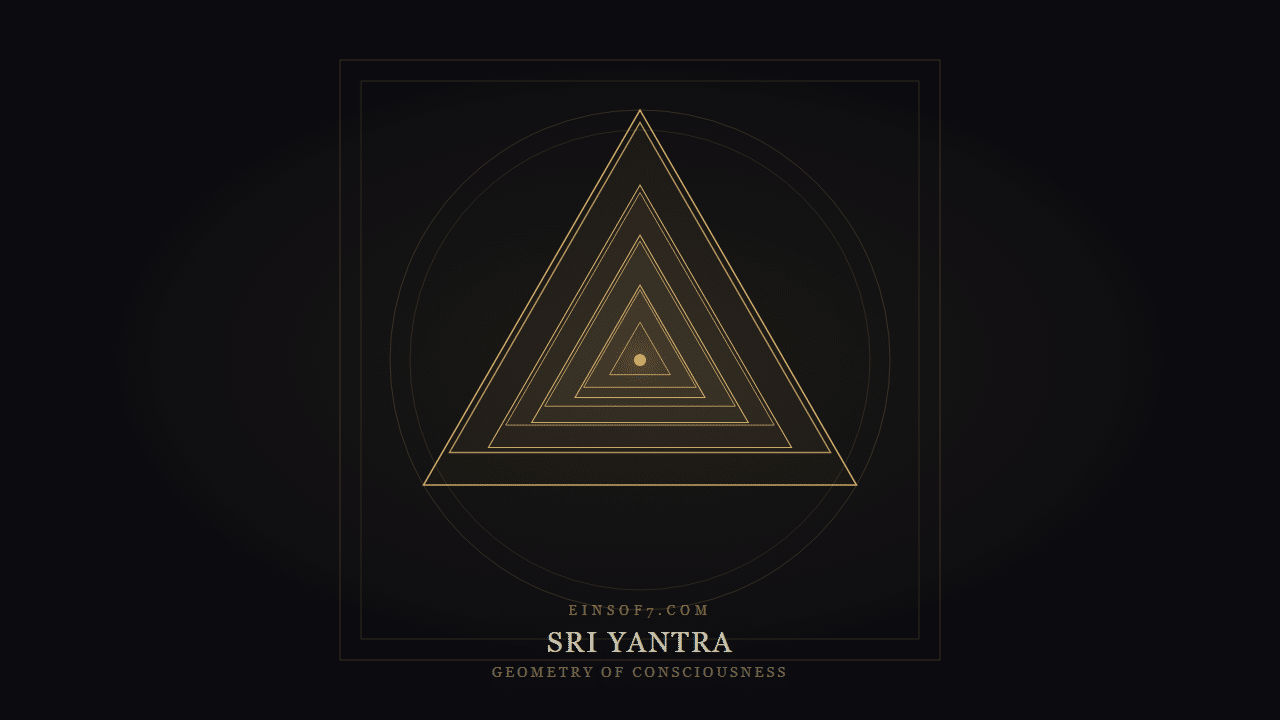
Western geometry usually focuses on the Golden Ratio. But the Vedic tradition reaches similar truths through a different door. Here, four upward triangles representing masculine energy meet five downward triangles representing the feminine. Their intersection creates forty-three smaller triangles. The structure mirrors how life itself works. The universe exists because of the tension between two opposing forces.
Look at the center of this web for a single point called the Bindu. This dot is the singularity where all physical matter begins its journey. Everything flows out from this silent center. When you see it in three dimensions, the flat drawing becomes a pyramid known as Mount Meru. Ancient architects and modern physicists both find this shape compelling because it maps the path from a single unity into the infinite variety we see every day. It shows how the one becomes many.
You don’t need a degree to feel the pull of this pattern. Honestly, the geometry speaks to a part of your mind that existed long before language. Understanding this symbol gives you a way to organize your inner noise. It acts as a visual anchor. The lines draw your eyes inward, back to the source.
The diagram isn’t static. It’s a blueprint for the way reality keeps unfolding.
🕉️ The Machine in the Temple: Decoding the Sri Yantra Meaning
You’ll find it nearly impossible to hold this entire image in your mind at once. Nine triangles interlock around a single center point. They don’t just overlap. These shapes weave together. If you try to draw this without following a strict mathematical formula, you will find that the lines simply refuse to meet in the right places. It’s precise. Every single intersection must align perfectly or the whole structure falls apart.
In the Shri Vidya tradition, this isn’t just art. It’s a tool. The word Yantra actually shares an ancient root with terms for a weaver’s loom or a complex piece of physical machinery. Think of it as an apparatus with a specific job. Its goal is the calibration of your consciousness.
Picture a priest in Kerala leaning over a dark stone floor. He holds white rice flour in his hand. He isn’t looking at a guide or a book. This geometry lives in his muscles. He’s drawing the Navayoni Chakra, which translates to the Wheel of the Nine Wombs, by moving his hand with practiced ease. He begins at the very center and works his way out. Here’s the thing: most of us look at the frame first. The Vedic perspective starts at the singularity.
The Asymmetry of Shiva and Shakti
The structure sits on a delicate tension. Four triangles point up. These represent Shiva, the masculine principle of stillness and stability. Five triangles point down. These represent Shakti, the feminine force of movement and creative power.
The numbers don’t match. It’s four against five.
This asymmetry is the point. Life isn’t a static equation. It moves. The dominance of the feminine downward triangles suggests that the physical world we inhabit is an act of power rather than a mistake. When these nine shapes cross paths, they create forty-three smaller triangles. These sit in layers. They show how one thing breaks apart into many.
The Bindu and the Silent Center
Right in the middle is the Bindu. It’s just a dot. In Tantric cosmology, this tiny point holds the potential of the whole universe. Think of it like a banyan seed. You can’t see the massive tree inside that tiny shell, but the blueprint for every branch and leaf is already hidden in that small space.
This dot is where the observer and the observed become one. The wall between you and the divine disappears. Adi Shankaracharya was a philosopher who focused on non-dualism and he often talked about this union. The dot is where everything begins and where everything ends. It’s the spot where the physical world falls back into pure potential.
Outer borders keep this energy inside. Lotus petals surround the drawing to show how life blossoms. Past the petals, you find the Bhupura. This square wall acts as a fence that separates the sacred geometry from the noise and chaos of the outside world. T-shaped gates face the four directions. They’re an invitation to leave the noisy world behind and look inside yourself.
📐 The Golden Measure: Western Order and Chaos
Greeks looked at form differently. Pythagoras and Plato hunted for eternal truths hidden in structure. They wanted to find the universe’s skeleton.
Platonists felt geometry spoke the soul’s language. They found five perfect solids – the tetrahedron, cube, octahedron, dodecahedron, and icosahedron. These shapes weren’t just math. They were the actual building blocks for fire, earth, air, ether, and water.
Western geometry likes to build. A geometer grabs a compass and a straightedge to start connecting points on a circle. Take the Vesica Piscis, which is just two circles overlapping to create the foundation for equilateral triangles and the square roots of 2, 3, and 5 in a sequence that feels totally logical.
Comparing Vedic and Platonic Maps
The Sri Yantra meaning meets Western thought at the center. But the path there is different. Western geometry leans hard on the Golden Ratio. You see this ratio in how nautilus shells spiral and pinecones grow. It’s the math of things you can touch.
The Sri Yantra is harder to pin down. It gets close to the Golden Ratio but doesn’t follow it exactly. Simple formulas don’t really work here because the triangles vary so much in size and shape. They aren’t uniform.
This irregularity tells you something about the philosophy. Westerners often love the idea of a perfect, static shape. Vedic diagrams track the vibrating process of life instead. It’s an admission that when Shiva and Shakti interact, they create a messy, interlocking web. Life is noisy.
The real connection is the goal. Both traditions use shapes to get past the talking part of the brain. A student of Plato didn’t study geometry to build bridges. They did it to train the soul to see truth. In the same way, the Shri Vidya practitioner uses the yantra to shut up the mental chatter. This shared purpose defines the history of sacred geometry across every culture. These lines are just a ladder for your mind to climb away from the boring stuff.
⚡ The Center is Everywhere: Converging on the Bindu
The real question is why people in ancient India and Greece both used triangles to talk about God. It’s a pattern. Our minds need a focal point.
Bindu point symbolism connects directly to how your brain works. It’s a physical link. Worth noting: researchers see a clear connection between yantra geometry and human physiology. Kathleen Karlsen argues that staring at that center point – a practice called Trataka – stimulates the pineal gland. It isn’t just a metaphor.
The Inward Gaze and Energy Body
People call the pineal gland the “third eye.” When you map out the energy body, moving from the outer square to that tiny center point mimics the way Kundalini energy rises.
Earth anchors the square while water fills the circles and fire burns in the triangles. Awareness lives in the center.
The yantra acts as a map for your inner life. Finding the middle is rarely a simple walk. It’s a messy process. Those forty-three triangles represent the maze of your own experience, which is often packed with layers of fear, ego, and desire. You have to work through the noise to find the quiet of the Bindu.
The labyrinth at Chartres Cathedral does the same thing. A pilgrim walks the winding path on the floor of the cathedral while a Vedic practitioner follows the sharp edges of the triangles with their eyes. The actions look different, but the goal is the same. Both try to pull the chaos of life into a single, silent spot.
👁️ Visual Silence: The Eye in the Storm
Your eyes face a constant assault. Screens and ads fight for every second of your attention, leaving you drained and distracted by the end of the day. The Sri Yantra offers visual silence. It looks complex, but it feels ordered.
Carl Jung noticed that mandalas show up in dreams when people feel like they’re falling apart. He saw these shapes as “holding environments” for the mind. When life gets messy, your brain tries to heal by creating a centered image that pulls order out of the surrounding chaos.
The Navayoni Chakra uses this exact principle. It doesn’t bother explaining the world. Instead, it just centers you. Honestly, those interlocking lines are designed to wear out your analytical brain by forcing you to follow paths that disappear at every intersection. You try, you fail, and you try again. Eventually, your logic gets tired. It just stops.
In that moment of surrender, your intuition takes over. You stop trying to solve the puzzle and simply let your eyes take in the entire shape at once. You see the whole.
Changing how you see is the whole point of the Shri Vidya lineage. You stop seeing the world as a pile of loose parts and start seeing a single field where everything connects to everything else. The “machine” of the drawing does its job. While the ink stays on the paper, the pattern moves into your head. Your inner noise settles around a fresh center. That quiet point in the middle becomes a map you carry with you.
The point is not the point. The center isn’t a place in space, but a stop in time. When you look at the edges, you see the many – when you rest on the Bindu, you see the One. The lines don’t hold the silence. They frame it. Entering the diagram means taking apart the person who built it.
🌐 The Convergence of Vedic and Western Forms
You might think of geometry as cold or just math. It isn’t.
Ancient builders saw structure as the very container for life, knowing that your consciousness needs a map to keep from drifting into the void. Without a center, you’ll drift. These interlocking triangles show the conflicts you face every day. Forces that seem to oppose each other don’t actually cancel out here. They weave together to hold the world up.
What’s interesting is how these traditions reveal the same human drive. Platonists build a solid shape to find something eternal in the outside world. A Vedic practitioner does the opposite. They dissolve the triangle to find that same eternity in a single internal point. One builds up and the other drills down. But they end up in the exact same spot. Geometry is just the language we use to talk about things we can’t quite name.
History shows us that people separated by thousands of miles reached for the same truths. Greeks looked for the golden mean in stone. Vedic masters drew nine wombs on the dirt to map out the heavens. Both tried to put the infinite into a box. Look at the diagram. It’s quiet. The triangles keep their tension, and right in the center, that single dot waits for your eye to return to the source of everything.
❓ Frequently Asked Questions
Who is permitted to use or wear the Sri Yantra?
Anyone can use it. This shape belongs to the world and doesn’t care about your background or status. Consider it a tool for focus. It works for anyone who wants to find a little more balance in their day. But if you want to get into the deep Tantric rituals, you’ll need a teacher from the Shri Vidya tradition to show you the ropes.
How does one activate a Sri Yantra?
It’s not like flipping a light switch. Activation is really about charging the metal or paper with your own intent and sound. You do this by chanting the Sri Suktam or specific seed mantras while you keep your eyes fixed on the center dot. Without that work, the shape is just a pretty design that needs your focus to become an active tool.
What is the primary purpose of the Sri Yantra?
Think of it as a machine for your focus. Here’s the thing. People often link it to wealth or success, but the real point is much deeper. It maps how the entire universe grows from a single point into complex shapes, which helps your mind move from a messy state to a clear one. By studying the geometry, you eventually learn to see the simple truth hidden inside your complicated and busy life.
For a broader understanding of this symbolic tradition, explore our complete guide to Sacred Geometry: The Hidden Blueprint of Creation.
* One more check: “Preserve ALL HTML tags exactly”.
Original: `
`, `
`, `
- `, ``, `
`.
Mine: `
`, `
`, `
- `, `
- `, ``, `