
This article is part of our Sacred Geometry series. Read the full guide: Sacred Geometry: The Hidden Blueprint of Creation
Five carved stones sit behind glass in the quiet halls of the Ashmolean Museum. They feel heavy and deliberate. These objects date back to the Neolithic period, a full millennium before Greek philosophy took root. Artisans in Scotland shaped them from rock long before Euclid wrote down his rules for geometry or defined the mathematical properties of a sphere. Yet, the platonic solids meaning starts right here. Humans have always looked for order in the world.
Greeks eventually gave these shapes the name we use today. To them, this kind of perfection wasn’t a fluke. It looked like a blueprint for reality. Only five regular convex solids can exist in three-dimensional space. This mathematical limit suggests the universe has rules. Think about that.
Plato wrote about these rules in his dialogue Timaeus. He didn’t see boring math in the angles. Instead, he saw the building blocks of everything we touch. The cube represents Earth because it’s stable. Fire belongs to the sharp tetrahedron, while Air fits the octahedron and Water matches the fluid icosahedron. The dodecahedron represents the stars or the ether that holds everything together.
You could dismiss this as primitive chemistry. That would be a mistake. This system tried to link the physical world to something deeper. It suggests that matter and spirit aren’t separate things. It’s a way to find meaning in the material by looking at the geometry we share.
Math shows us the world isn’t random. It has a foundation. Ancient thinkers didn’t just use geometry to measure land. They used it to look directly at the hidden architecture of the divine.
🏛️ The Silent Stones of Scotland
Long before Plato wrote about the universe or Euclid drafted a single proof, someone in northern Scotland picked up a heavy rock. This happened around 3000 BCE. These Neolithic makers carved stone balls with strange, symmetrical bumps that still baffle experts today. It’s a mystery.
You can hold them in your palm. Some have three knobs, while others have dozens. A few show the exact symmetries of the platonic solids meaning we talk about in modern classrooms. You’ll find examples at the Ashmolean Museum in Oxford that look like they belong in a geometry textbook from thousands of years later.
Imagine a craftsman sitting by a fire in Orkney while the wind screams against stone walls, holding a piece of granite that will eventually become a masterpiece. He isn’t using a compass. Instead, he’s trusting his hands. The granite gets ground down until the weight feels perfectly balanced. He wants a shape that doesn’t lean or wobble.
He finds the tetrahedron through touch. No equations needed.
Some skeptics claim these neolithic carved stone balls don’t actually prove the makers understood math. Many of the stones are lopsided. They don’t always meet the rigid standards of convex regular polyhedra that a mathematician would expect when they analyze the angles and faces. But you can’t ignore the drive behind them. Humans want symmetry. We look for patterns that repeat until the world feels orderly.
The Greeks eventually wrote down the rules for what these people felt. The stone wasn’t just a tool. It was an idea.
🔥 Timaeus and the Atomic Geometry
The Timaeus elemental theory is a piece of philosophical poetry. You have to remember that Plato didn’t have a microscope to see atoms. He relied on pure logic to figure out how the universe worked by looking at the way materials felt and reacted to the world around them. Pattern-seeking was his method. He looked at how things behaved and worked backward to find their shapes.
He started with the tetrahedron. This shape has four triangular faces and sharp, stabbing points. Plato thought fire must look like this because it pierces and separates materials while moving quickly with a heat that feels sharp to the touch. It feels sharp when it burns you. The tetrahedron fire element link comes from that physical sensation. It’s the geometry of action.
Then he looked at the ground beneath your feet. Earth is solid and supports your weight without moving or flying away easily while remaining the most reliable surface in the physical world. Plato gave the cube – or hexahedron – to this element. It’s the only solid that stacks perfectly without any gaps. A hexahedron earth symbol represents stability because it sits flat. It’s hard to tip over. It stays exactly where you put it.
The octahedron air representation uses a similar logic but with a lighter touch. Air moves around you and feels soft, yet it still has a presence. This shape has eight triangles and looks like two pyramids joined at the base, allowing it to spin easily on its axis as a medium for movement. It feels light. The shape represents a state of suspension that allows movement.
Finally, you have water. Water flows and rolls and slips right through your fingers. Plato gave the icosahedron water association to this element. It has twenty faces, which is more than any other Platonic solid. Because it has so many small faces, it’s the closest thing to a sphere and moves like a ball bearing to mimic the way liquid flows. It rolls. Fluidity is the key here.
This isn’t modern science. It’s a symbolic language. He wanted to understand the character of matter by looking at sacred geometry meanings.
🌌 The Fifth Shape and the Cosmos
A problem remained. The Greeks saw four earthly elements, but the Pythagorean solids offered five distinct shapes. While the tetrahedron, cube, octahedron, and icosahedron explained the physical world, the math produced a fifth option that didn’t fit the map. It was an outlier.
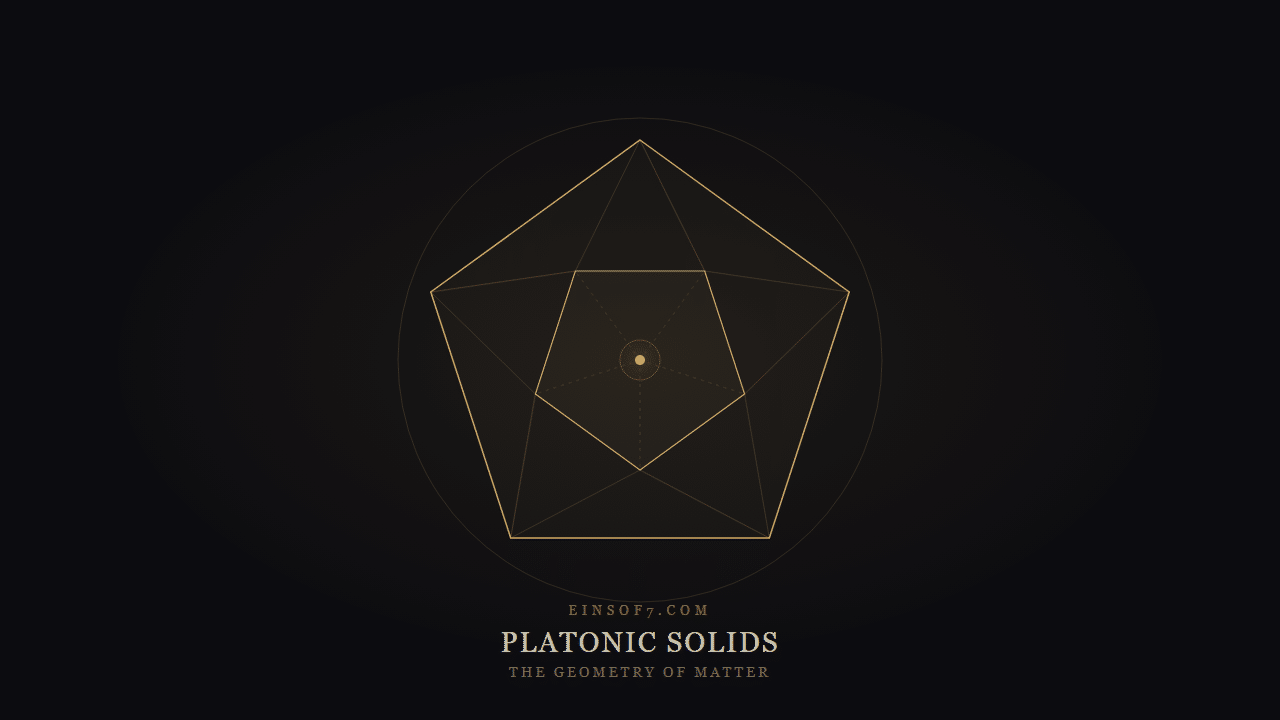
Twelve pentagonal faces make up the dodecahedron. It stands apart. It is quite complex.
Plato wouldn’t leave the shape behind. He wrote that the creator used this final form to arrange the constellations across the heavens, which gave us the ether dodecahedron symbolism. It came to represent the universe itself or the Aether, the substance that supposedly filled the vast space above the moon. It’s the bridge between math and the stars.
This shape carries a certain weight of mystery. Pythagorean traditions actually kept its existence a secret for a long time. Legends even say they drowned Hippasus because he told outsiders about irrational numbers and the construction of the dodecahedron. Secrets had high stakes back then.
The dodecahedron represents what lies beyond your immediate physical world. Think of it as a container. If the other four shapes are the contents of a jar, this shape is the glass itself. It defines the boundaries of the entire system.
Later alchemists called this the Quintessence. It is the fifth essence or the spirit that moves the mechanics of the other four elements. This concept ties the cosmic solids together into a single theory of existence.
📐 The Severity of Euclid’s Proof
People obsess over these shapes because they’re rare. They aren’t just artistic choices. They’re mathematical requirements.
Euclid proved in his Elements that no other options exist, showing us that our three – dimensional world allows exactly five regular convex polyhedra. You can’t build a sixth. Geometry’s laws won’t allow it.
Try joining three hexagons at one corner and you’ll end up with a flat plane instead of a solid shape. If you attempt it with three heptagons, the whole thing overlaps and falls apart. Nature only permits five versions of perfect symmetry.
This strict limit makes the solids feel special. They’re a discovery rather than something humans invented. Here’s the thing: they exist in a world of pure form that doesn’t care about our opinions.
In the 19th century, Schläfli showed that this scarcity depends entirely on where we live because four – dimensional space has six regular bodies, while anything higher than five dimensions only has three. But here in our three – dimensional home, five is the final number. It’s a hard limit.
This math gives sacred geometry meanings a solid foundation. It suggests that spiritual symbols rest on the hard floor of reality. We live in a world with specific rules.
This idea connects physical limits to metaphysical truths and remains a major part of the history of sacred geometry.
💡 The Modern Search for Structure
Science moved past the Timaeus theory long ago. You likely understand that fire is a chemical reaction rather than a collection of tiny, sharp pyramids. Water is just H2O. It isn’t a pile of twenty-sided dice.
But the symbols stick around. Why do you still look for a perfect cube in such a jagged world?
The platonic solids meaning shifted from literal physics to a way to steady your mind. It’s a psychological trick. In a world that feels increasingly messy, your brain rests on these shapes because they represent a baseline of order. Werner Heisenberg even noted that modern particles look more like Plato’s math than Democritus’s solid atoms. They are defined by symmetry rather than physical substance.
Designers put them in logos to signal stability. Artists use them. You see them in digital worlds as Kepler-Poinsot polyhedra or wireframe meshes that form the hidden skeleton of every video game you play. It’s math made visible.
You feel the same pull a Neolithic carver felt thousands of years ago. Nature is organic chaos. Trees grow in fractals and clouds have no edges while the coastline is always jagged and unpredictable. But the cube is perfect. The tetrahedron is absolute.
When you place a quartz crystal cut into a dodecahedron on your desk, you aren’t calculating its volume or thinking about geometry. You’re performing a very old ritual. You are bringing a symbol of the universal into your personal space to find balance.
🧭 Attuning to Geometric Presence
Feeling these shapes isn’t some academic exercise. It’s about balance. You don’t need to analyze a cube to feel the heavy, settling sensation it gives you. It’s a visual anchor. When life feels scattered or too fast, that flat-sided solidity acts as a counterweight that pulls your attention back down to the ground. It just works.
Compare that to a tetrahedron or an icosahedron. These shapes feel different because they’re ready to roll or pierce. Fire’s sharp angles suggest you can cut through the noise. It’s about resonance. The many-faced water element feels ready to shift. The real question is: what’s missing right now? You aren’t studying these forms for a grade, but instead you’re looking for the specific shape that mirrors what’s missing in your own internal landscape.
🌙 The Geometry of Intuition
We keep returning to these five forms.
Usually, science moves forward by throwing things away. We stopped believing the Earth sits at the center of everything and we quit treating illnesses with the four humors. But we never threw out the Platonic solids. Instead, we keep them close and look for new ways to see ourselves in their edges.
It’s because they aren’t just descriptions of rocks or stars. They show how your mind makes sense of the world.
You need categories. It’s helpful to know what stays still like Earth and what burns away like Fire. You have to tell the difference between a simple cube and an abstract dodecahedron.
These metaphysical shapes act as your map. They bridge the gap between the messy data you feel every day and the quiet clarity of actually knowing something.
Johannes Kepler tried to shove the entire solar system into nested Platonic solids. He failed the astronomy test. Planets don’t move like that. But he was right about the beauty of the idea. He knew the universe follows a logic we can eventually find.
A Scottish stone carver, an Athenian philosopher, and a digital artist in Tokyo are all doing the same thing. They hold these shapes up against the dark. It is an act of trust that the universe has a shape worth finding.
Final Reflections on Geometric Order
We don’t carve granite by firelight anymore. But the hunger for structure stays with us. Most days feel like the wind howling outside those Orkney walls, a shapeless rush of events that leaves you feeling a bit lost. You want a logic that makes sense of the mess. Finding a pattern isn’t just a mental exercise. It’s a survival instinct.
The real geometry lives inside you. You feel the sharp heat of the tetrahedron during moments of sudden passion, while the heavy stability of the cube becomes a necessity when the ground beneath your feet starts to shake. These shapes aren’t just outdated chemistry. They’re maps for your inner world. Balance is a constructed thing. Order doesn’t happen by accident because you have to work for it. It takes a deliberate hand to smooth out the rough edges.
The old artisans knew this best. They understood that you have to feel a truth to believe it. Honestly, meaning isn’t always some high concept hidden in the distant stars because sometimes it is simply a heavy, balanced stone resting right in your palm.
❓ Frequently Asked Questions
Why are there only five Platonic solids?
Euclid proved this is a hard limit of our physical reality. To make one, you need identical regular shapes meeting at each corner in the exact same way. Math has limits. If you try to force a sixth version, the angles won’t close up properly and you’ll end up with a shape that either stays flat or overlaps itself. It’s just how 3D space functions.
What is the spiritual significance of the Dodecahedron?
The Greeks linked the first four solids to earth, air, fire, and water. That left one shape out. They decided the dodecahedron represented the cosmos or the spirit, serving as a spiritual container for the physical elements that make up the world around us. We call it the fifth essence. It’s the spark that animates every single piece of matter you see and touch.
Did the Neolithic Scots actually understand the geometry?
They probably didn’t write down formal proofs. But they didn’t have to. The carved stone balls they left behind show a deep, tactile grasp of symmetry. These ancient builders found the shapes by working the stone with their hands, proving that these geometric truths are intuitive to the human mind. You don’t need a textbook to recognize perfect balance.
If you want to see how this tradition fits into a larger picture, read our full guide to Sacred Geometry: The Hidden Blueprint of Creation.
Where to go next
Check these out. You’ll find them helpful. These guides explain the deep history and geometry behind some of the most famous patterns in existence.

Dalton Treviso is an independent researcher and writer exploring archetypes, Jungian psychology, and mythological symbolism. His work focuses on how ancient philosophical traditions and symbolic systems illuminate the hidden structures of the human psyche.
Drawing on Jungian psychology, Stoic thought, and comparative mythology, Dalton examines how the inner patterns we carry shape perception, conflict, and transformation.
Through EINSOF7, he writes about the symbolic architecture of the mind — exploring how myths, archetypes, and philosophical traditions act as both mirror and map for psychological depth and self-understanding.
Areas of study: Jungian archetypes, animal symbolism, dream symbolism, mythological figures, and ancient symbolic traditions.