
This article is part of our Ancient Symbols series. Read the full guide: Ancient Symbols: The Hidden Power That Drives Us
In the damp workshops of the Middle Kingdom, artisans painted pairs of eyes on wooden coffins. These painted symbols served a vital function. The dead needed to see out into the living world. Among these images, one specific mark held unmatched power. The true eye of horus meaning involved a violently fractured vision made whole again.
Egyptian tradition describes a brutal family conflict. During battle, the dark god Set gouged out his nephew’s left eye. He did not just blind Horus. Set tore the eye into six distinct pieces and scattered them across the land. Later, the god of wisdom restored the fragments. Thoth bound the shattered pieces back together with magic. Because the left eye was the lunar eye, it governed the shadowed, hidden aspects of perception. The restoration gave birth to the wedjat, the whole or uninjured eye.
Today, the symbol appears as a simple protective amulet on jewelry or in museum displays. Yet the original narrative holds a profound psychological mirror. Trauma and conflict routinely shatter perception. The scattered pieces of the eye mirror fragmented attention and fractured identity. Healing requires gathering those lost parts of the psyche to allow true inner vision to return.
Horus did not keep his healed eye. Offering it to his murdered father in the underworld, this act of sacrifice brought the dead back to life. A restored mind protects the individual while holding the power to revive what was lost in the dark. The ancient Egyptians understood something vital about human awareness. True sight is rarely given freely at birth. It must be broken, gathered, and carefully rebuilt.
🦅 The Osiris Myth: Blood and the Falcon’s Succession
To steal the throne, Set murdered his brother Osiris and dismembered the king into fourteen pieces. The mutilation prevented Osiris from entering the underworld intact. Horus, the son of Osiris, challenged Set to avenge this death. Raging across the desert sands and riverbanks, the Horus vs Set conflict was vicious. During their battle, Set tore out Horus’s left eye and shattered it into six distinct fragments, scattering these pieces across the land.
The god of magic and wisdom then gathered the scattered pieces. Thoth healing magic bound the fragments, though in some variations, Hathor restoration brought the eye back to life. The healed eye became the wedjat, an ancient word translating to the whole or sound one. Horus offered this restored vision to his murdered father rather than keeping it for himself. Containing intense revitalizing power, the eye secured the Osiris myth resurrection. Offering the eye established the ultimate template for Egyptian funerary offerings. Every physical gift given in a temple mirrored this divine sacrifice, making the eye the eternal symbol of sustenance.
🌙 The Waxing Moon: Cycles of the Wedjat’s Regeneration
The ancient Egyptians saw the lunar cycle as a celestial drama. The waxing and waning moon reflected physical injury and recovery. Through the lunar symbolism Egyptian mythology utilized, the sky became a living text. Priests watched the moon lose its shape each month, interpreting the shrinking sliver as Set attacking the eye again. As the moon shrank, the eye was torn apart. As it grew, Thoth was binding the fragments together.
The moon’s return signaled Thoth’s success. A full moon meant the eye was whole again, signifying constant mythological regeneration. Governing hidden perception, the left eye was the moon. It was conceptually paired with the right eye, the sun. Comparing it to the Eye of Ra reveals a different energy entirely. The right eye carried a fiery, aggressive force that burned the enemies of the sun god. Left wedjat eye symbolism focused on healing, governing the shadowed, unseen aspects of life. The moon rules the night, and the night requires absolute protection.
🧮 The Mathematics of Perception: Six Fragments of the Eye
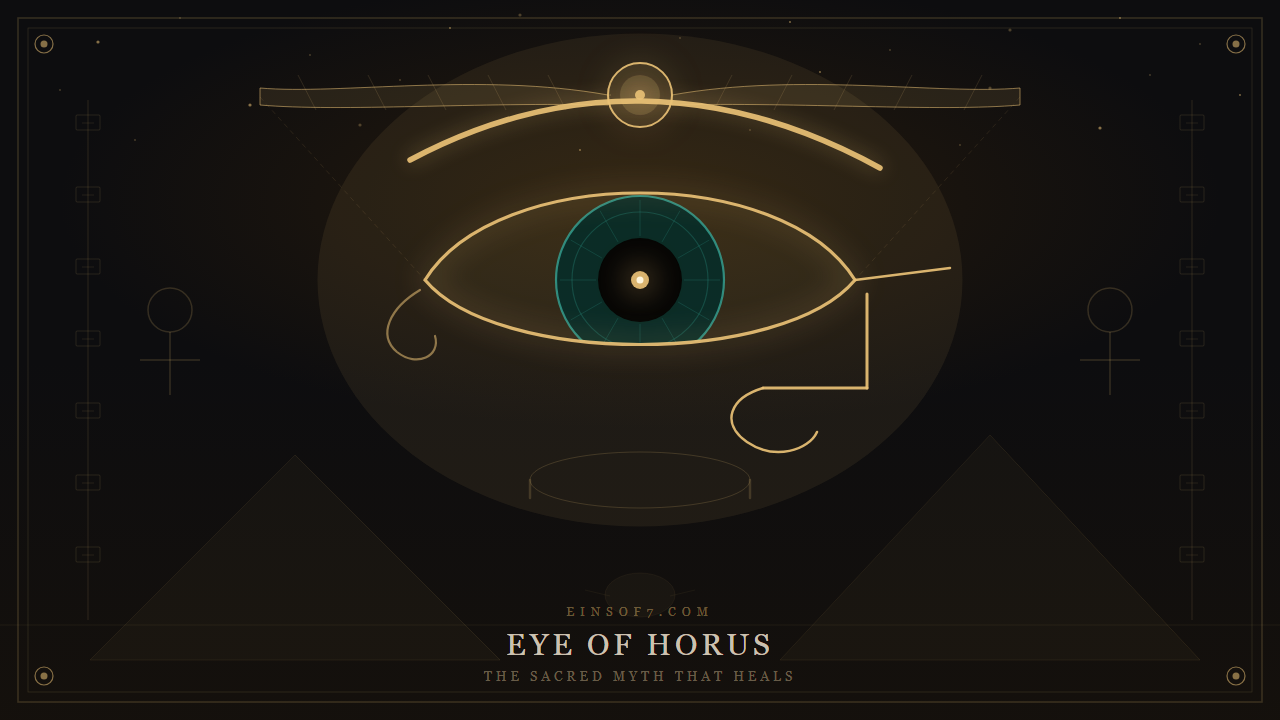
The scattered pieces of the eye became a mathematical system. Scribes used the symbol to measure grain and medicine, assigning each part of the eye a specific fraction. The inner corner pointing to the nose was one half. The pupil was one quarter. The eyebrow was one eighth. The outer corner was one sixteenth. The curving line was one thirty-second. The descending line was one sixty-fourth.
These fractions governed daily commerce. By adding the six pieces together, scribes created sixty-three sixty-fourths. The total never quite reaches a perfect whole. The missing final fraction signifies Thoth’s magic, as the gods supply the final piece to make things whole. This carries a quiet philosophical weight. Perception is never entirely complete. Human vision is always missing a tiny fraction of reality. A piece of the truth always remains hidden. The complete picture requires a leap of magical synthesis. Understanding this limitation, ancient scribes built it into their daily accounting to remember that mortal vision remains imperfect.
🧿 Apotropaic Stones: Carving the Eye in Faience and Lapis Lazuli
The stylized eye possessed apotropaic magic ancient Egypt relied upon to avert evil influences. It turns away bad luck before it strikes. Craftsmen carved these amulets from specific materials. For the poor, blue faience was the most common choice, its vibrant blue glaze mirroring the open sky. Wealthier families used lapis lazuli or carnelian.
Placing these amulets on a mummy, a priest would wrap the charm tight against the throat. The cold faience stone pressed against dried flesh, ensuring the dead could see their way through the dark and protecting the vulnerable throat from underworld demons. The symbol acted as a permanent, unblinking guardian. Spiritual protection amulets protected the living too. Mothers tied them to the wrists of young children. Soldiers carried them into battle against foreign armies. Painted on Middle Kingdom coffins, the dead used them as windows to watch the sunrise. The symbol provided both sight and an impenetrable shield against the chaotic forces of the desert.
But did these ancient priests understand the physical mechanics of sight as intimately as the spiritual?
🧠 Flesh and Form: Horus in Ancient Egyptian Medicine Art
Beneath the myth, the shape maps a precise physical reality. It features highly specific anatomical markings mimicking a falcon. A curving line extends downward, resembling cheek feathers, while a straight line drops from the pupil. Horus was the falcon-headed sky god. Ancient Egyptian medicine art was highly advanced. Understanding anatomy deeply through mummification, priests pulled the brain out through the nasal cavity and mapped the inner shapes of the skull.
A 2019 paper in the medical journal Cureus examined a striking visual parallel. Authors ReFaey, Quinones, and Clifton mapped the eye, overlaying the symbol onto a human brain scan. A cross-section of the midbrain matches the symbol perfectly. The corpus callosum forms the curving eyebrow. The anterior commissure shapes the round pupil. The medulla forms the straight descending line. The neuroanatomy Eye of Horus connection is visually undeniable. Associating specific senses with each fraction, the Egyptians represented smell, sight, thought, hearing, taste, and touch. The symbol mapped the physical structures of consciousness itself.
🌍 Beyond the Nile: The Coastal Spread of the Falcon’s Mark
Over time, the symbol broke free from its homeland. Its reputation as a protective ward crossed borders, spreading into neighboring non-Western regions. Artisans in Nubia began carving it into their monuments. It traveled up the Mediterranean coast to Canaan and Syria. A Phoenician sailor might paint the eye on his ship, the wet pigment dripping down the wooden bow as the eye stared out at the violent, unpredictable sea.
The massive vessel needed to see hidden reefs, making this protective warding a universal language. As one thread in the wider history of ancient symbols, the image outgrew its specific mythological origin. Stonemasons adopted it as a formalized hieroglyph protection mark, carving the shape into heavy boundary stelae. These stones marked the edge of safe territory. Beyond the markers lay the chaotic desert. Standing at the threshold between order and ruin, the eye warned hostile forces that the border was watched.
🌑 The Shadow Dimension: Set and the Necessity of Chaos
Within the myth lies a deep, unavoidable shadow element. The Eye of Horus cannot exist without Set, the ultimate agent of destruction and the necessary force of chaos. Without the mutilation, there is no magical restoration. The eye draws its power from surviving the breaking. Set embodies the brutal, unavoidable fractures in life, tearing apart what seems stable and permanent.
The unbroken eye possesses no magic. The wound itself generates the power. Healing forces a new reality. Suffering forces a deepening of perception. Horus gains the power to resurrect his father through injury, as the unblemished god cannot enter the underworld. Only the broken god can sustain the dead. The myth also notes that Set lost a testicle during the battle. Both gods suffered permanent, altering mutilation. Order and chaos permanently scarred each other. Carrying the memory of this violence, the restored eye incorporates the shadow into its new vision rather than pretending the breaking never happened.
👁️ Inner Vision Psychology: Gathering the Fragments of Horus
The myth of the broken eye holds enduring psychological weight. Trauma or profound loss can shatter how someone sees reality. After such events, the world splinters into confusing, disconnected fragments. Nothing aligns. The story of Horus maps this human experience with uncomfortable precision. His blinding was violent and sudden, and losing his eye meant losing his basic orientation.
Yet the myth insists that the broken pieces remain. Scattered across the inner landscape, they are never truly destroyed. Healing requires gathering those specific fragments back together – a process demanding time, wisdom, and deliberate effort. Thoth signifies the slow, deliberate magic of integration.
Violently broken and carefully remade, the restored eye is never identical to the original. This history gives the symbol a new depth of vision capable of perceiving the underworld and sustaining the dead. Grief obliterates the old way of seeing. A new, fractured reality takes its place. Eventually, those scattered fragments form a new whole. Scarred but functional, the restored vision sees the dark and survives the night.
🧭 The Lived Experience of the Restored Eye
Living with restored perception feels fundamentally different from the innocence of unbroken sight. There is a distinct gravity to looking at the world through a lens that has been shattered and reassembled. The sharp edges of past fractures do not disappear – rather, they frame how reality is perceived moving forward. When someone navigates a major loss, the initial disorientation mimics that ancient scattering in the desert. Slowly, as the fragments of identity are gathered back together, a new kind of awareness takes shape. This awareness is acutely sensitive to the fragility of things, yet simultaneously grounded by the knowledge of its own survival. It is the profound realization that sight can endure the dark, and that enduring the dark alters what the eye is capable of seeing.
The Missing Fraction of the Wedjat
That missing sliver of the mathematical equation exposes a quiet truth about human healing. We rarely return to perfect wholeness. Trauma shatters inner vision just as Set scattered the divine eye. A sudden loss tears reality into jagged pieces. Gathering the fragments of identity takes profound patience and immense effort. Even after putting the pieces back together, a tiny gap remains.
This slight imperfection is not a failure of the recovery process. It is simply the space where grace enters. Ancient scribes left that final fraction empty for divine magic to fill. Modern minds might call it pure acceptance, or the lingering mystery of human resilience. Whatever fills that void acknowledges that broken things change permanently. A healed mind functions differently than an untouched mind. The restored eye views the world with the clarity of survival.
A reconstructed self carries the heavy memory of its own shattering. We offer our healed vision to those around us, and this shared sight revives others trapped in the dark. The night sky still watches the moon wax and wane. Collecting our scattered pieces in the shadows, we slowly assemble the fragile shape of what we lost. Yet that final fraction stays just out of reach.
For a broader understanding of this symbolic tradition, explore our complete guide to Ancient Symbols: The Hidden Power That Drives Us.
Explore Related Topics

Dalton Treviso is an independent researcher and writer exploring archetypes, Jungian psychology, and mythological symbolism. His work focuses on how ancient philosophical traditions and symbolic systems illuminate the hidden structures of the human psyche.
Drawing on Jungian psychology, Stoic thought, and comparative mythology, Dalton examines how the inner patterns we carry shape perception, conflict, and transformation.
Through EINSOF7, he writes about the symbolic architecture of the mind — exploring how myths, archetypes, and philosophical traditions act as both mirror and map for psychological depth and self-understanding.
Areas of study: Jungian archetypes, animal symbolism, dream symbolism, mythological figures, and ancient symbolic traditions.