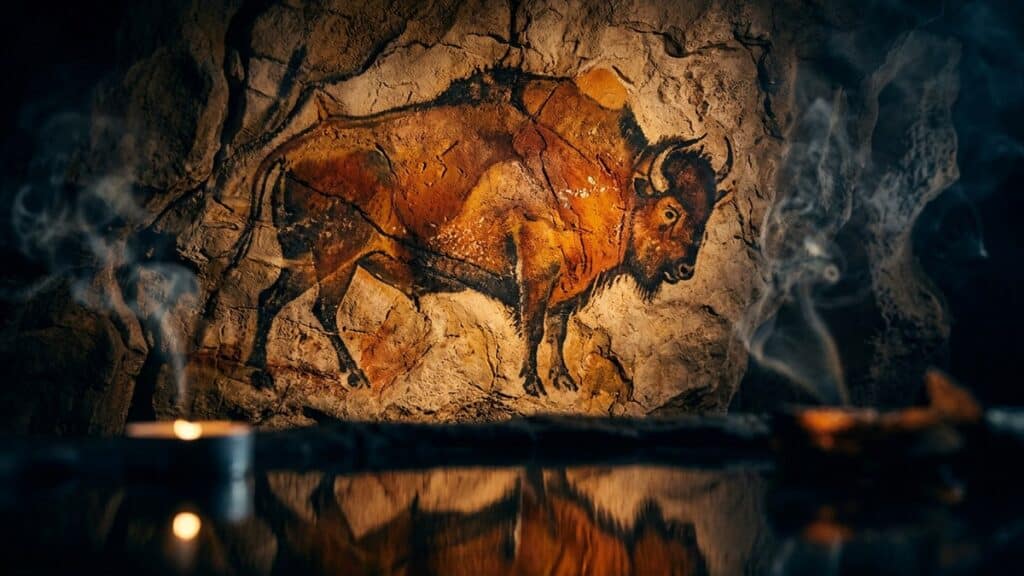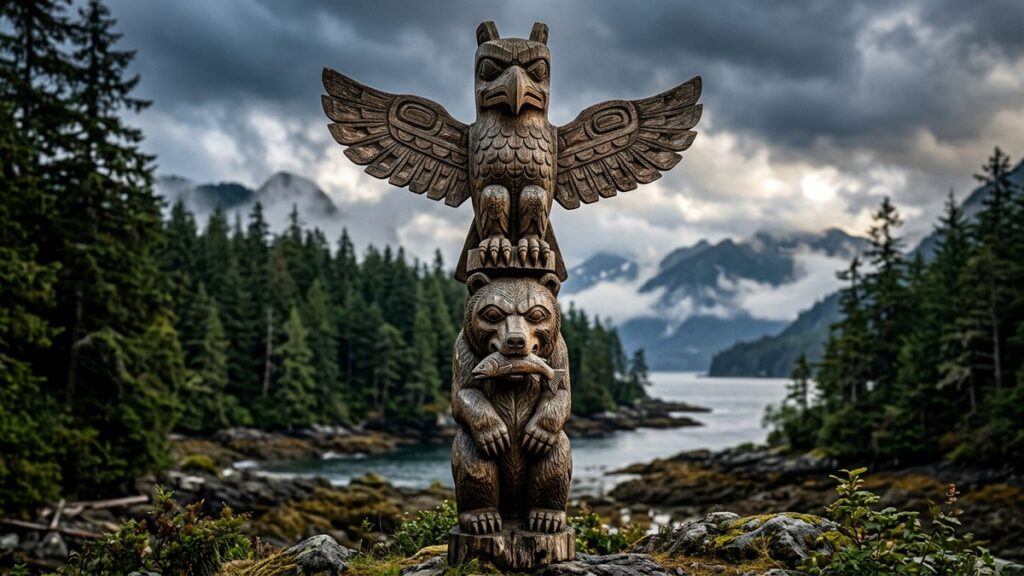
A Mapuche shaman strikes the ceremonial drum, where a painted map of the cosmos stretches across tight animal skin. This specific Kultrun actively organizes the chaotic universe into four distinct, manageable quarters, rather than merely decorating a ritual space. We carve ancient symbols into wood and stone to hold the infinite in our bare hands. The human mind constantly requires physical anchors for invisible, abstract realities.
Modern commercial culture often reduces these powerful marks to mere aesthetics or simple corporate logos. Yet the original creators demanded far more from their sacred iconography. The Asante people of West Africa traditionally stamped Sankofa birds onto heavy mourning garments. This striking image of a bird looking backward carried a heavy philosophical demand. It told the grieving community to pull wisdom from the past before moving forward.
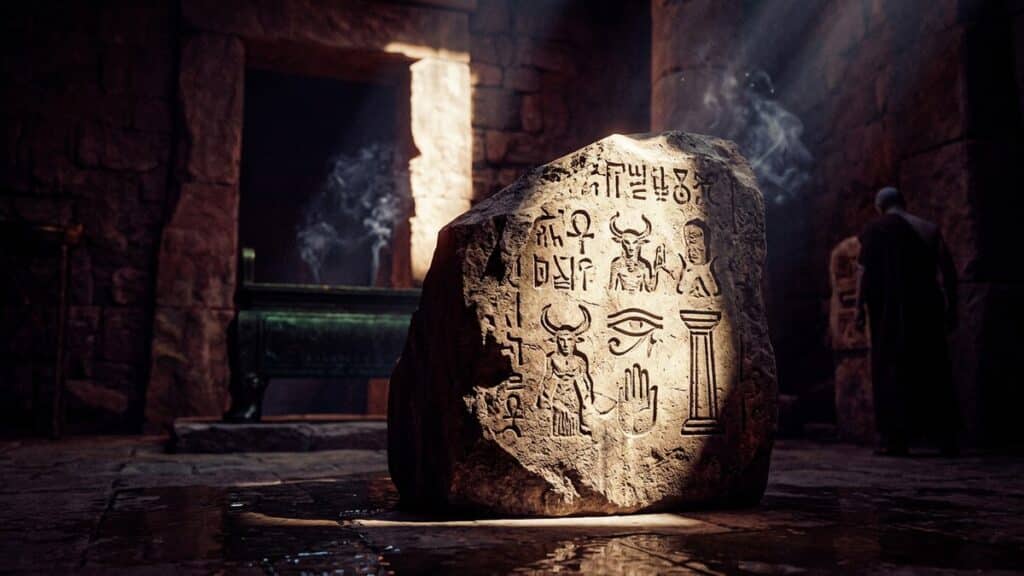
These geometric shapes and animal figures function as fundamental psychological architecture. They actively structure our internal understanding of time, grief, and complex human behavior. Mayan priests tracked elaborate dynastic histories and agricultural cycles through highly complex hieroglyphic scripts. Each carved glyph acted as a necessary bridge between earthly survival and divine order. A true sign bypasses the conscious, analytical brain entirely to speak a silent language.
We still dream in these exact same geometric patterns today. The conscious intellect forgets the old gods and the complex agricultural calendars. Our deeper unconscious mind remembers their ancient shapes perfectly. A carved stone from centuries ago still mirrors our most private, modern anxieties about survival. These enduring marks map the hidden, permanent structures of human thought.
🗿 The Universal Cipher: How Ancient Symbols Organize the Unknown
Human cultures face an identical problem across separate continents and millennia. Abstract concepts like time, mortality, cosmic order, and psychological integration remain formless and invisible. Ancient symbols act as precise compression mechanisms, translating these massive philosophical realities into physical marks that the mind can grasp, hold, and manipulate.
The physical application of these marks exposes their original utility. Fourteenth-century Aztec codices and temple architecture relied heavily on cosmological motifs to track agricultural cycles and direct political expansion. The symbol did not merely depict the sun or the rain; it served as an active ritual tool used to appease deities and guarantee the survival of the confederation. Mayan archaeological symbols, including the complex hieroglyphic script and the Tzolkin calendar, functioned as sophisticated instruments for divination and the recording of dynastic histories. Deciphering these glyphs completely altered the socio-economic understanding of pre-Columbian America, proving that sacred geometry often masks highly advanced mathematical observation.
| Tradition | Symbol | Core Meaning |
|---|---|---|
| Asante (West Africa) | Sankofa | Examining past failures is necessary to secure future progress. |
| Maya (Mesoamerica) | Tzolkin Glyphs | Divine order dictates agricultural cycles and dynastic history. |
| Egyptian | Wadjet Eye | Broken parts can be restored into a functional, protected whole. |
| Norse | Yggdrasil | A central pillar connects the sky, earth, and subterranean depths. |
| Hindu | Sri Yantra | Interlocking geometry provides a strict map for inward meditation. |
This practical utility extends far beyond agricultural planning. When scribes pressed styluses into wet clay to create Babylonian cuneiform tablets, the evolution from pictograph to abstract symbol marked a radical shift in human cognition. A mark no longer had to look exactly like a sheaf of wheat to carry the commercial and spiritual weight of the harvest.
West African Adinkra symbols operate on a similar frequency. Originating from the Asante people, these striking visual aphorisms convey dense ethical codes. The Gye Nyame symbol projects the absolute supremacy of divine power, while the Sankofa bird encodes the psychological necessity of examining past failures to secure future progress. Weaving these marks into heavy mourning cloth transformed ordinary grief into an organized communal ritual. Across the globe, these visual anchors prevent human consciousness from buckling under the weight of an infinite, chaotic universe.
👁️ The Wadjet Eye: Protection and Inner Vision
Egyptian mythology centers heavily on the violent conflict between order and chaos, famously personified in the battle between the deities Horus and Set. During this mythic struggle, the falcon god Horus loses his left eye. The moon god Thoth restores the shattered pieces, creating the Wadjet—a powerful emblem of healing, completion, and fierce physical protection. Ancient painters routinely applied this distinct stylized eye to the bows of ships and the entrances of rock-cut tombs to ward off malevolent forces.
Yet the image carries a heavy psychological weight that outlasts its original context. The specific lines mirroring the facial markings of a falcon represent sharp, unclouded perception. The restored eye demands clear sight, asking the observer to look past surface illusions and recognize deeper truths. It became an enduring psychological representation of inner vision and personal integration. The mathematical fractions hidden within the swoops and curls of the drawing expose an ancient understanding of how broken parts assemble into a functional whole.
Read the full guide: The Mythology and Psychological Meaning of the Eye of Horus →
🌳 The World Tree: Roots in the Underworld
The vertical axis of the cosmos requires a sturdy structural metaphor. The world tree motif appears independently across continents, acting as the central pillar connecting the sky, the earthly plane, and the subterranean depths. Norse mythology places the massive ash tree Yggdrasil at the center of the universe, with its branches holding up the heavens and its roots burying deep into the land of the dead. Mesoamerican cultures, particularly the Maya, viewed the towering Ceiba tree as the primary conduit for souls traveling between the underworld and the celestial sphere.
Celtic knot architecture exposes a similar obsession with the sacred oak. The continuous, unbroken lines weaving the roots and branches together express the deep interdependence of all living things. The tree provides a perfect map for human psychological development. The roots plunge into the dark, fertile subconscious, the trunk stands firmly in waking reality, and the high branches reach toward higher states of awareness. Different cultures adapted the exact species of the tree, but the structural function remains uniform.
Read the full guide: Unlocking the Tree of Life Across Global Traditions →
☥ The Egyptian Ankh: Breath and Eternity
The distinct looped cross of the Egyptian key of life dominates the visual landscape of ancient Nile Valley ruins. Carved deep into temple columns and painted vibrantly onto sarcophagi, the shape frequently appears in the hands of major deities like Isis and Osiris. Sacerdotal priests and royal figures held the object by its loop, treating it as a physical and figurative key capable of unlocking the gates of the afterlife.
Funerary rites utilized the shape heavily. Reliefs often depict gods pressing the cross directly to the lips of a deceased pharaoh, offering the breath of eternal life required to survive the dangerous passage through the underworld. The ancient Egyptian view of eternity differed wildly from modern concepts of a static heaven. The combination of the vertical line, horizontal bar, and open loop reflects an ongoing, dynamic cycle of existence, generation, and renewal. Understanding how mortal time intersects with the immortal soul requires looking closely at the precise geometry of this ubiquitous artifact.
Read the full guide: The Egyptian Ankh and the Ancient View of Eternity →
📐 The Sri Yantra: Geometry for Attention
Eastern philosophies frequently rely on precise spatial patterns to direct the wandering human mind. Originating in ancient India, the Sri Yantra consists of nine interlocking triangles radiating outward from a single central dot, or bindu. This Hindu geometric symbol operates as a strict, visual machine designed to alter states of consciousness, completely bypassing narrative storytelling.
Four triangles point upward, representing masculine energy, while five point downward, channeling feminine power. The complex intersection creates forty-three smaller triangles, surrounded by concentric circles and lotus petals. The arrangement functions as an intricate map for meditation rather than a mere decorative object. Practitioners use the sharp angles and converging lines to pull their scattered awareness inward, shifting focus from external anxieties toward the quiet center of the self. Buddhist spiritual symbols later adapted similar geometric principles to aid concentration. The scattered fragments of human attention require practical, step-by-step engagement with the pattern to integrate.
Read the full guide: How to Use the Sri Yantra for Deep Meditation →
🌸 The Flower of Life: Mathematics as Mysticism
Overlapping circles arranged in a strict hexagonal pattern create one of the most widespread sacred geometry symbols on the planet. Burned into the massive stone columns of the Osirion temple at Abydos in Egypt, the design echoes across global mysticism, appearing in ancient Chinese palaces, medieval European cathedrals, and Middle Eastern mosques. The exact mathematical proportions dictate the spacing, creating a flawless visual harmony.
Ancient architects and philosophers viewed mathematics not merely as a system for measuring material, but as the fundamental language of creation. The nineteen complete circles contain smaller, intricate patterns like the Seed of Life within their interlocking arcs. Esoteric occult glyphs frequently borrow this structural foundation to map out cosmic laws. The drawing suggests that beneath the chaotic surface of the natural world lies a tight, perfectly ordered grid. The mathematical and spiritual origins of this hexagonal grid expose how ancient builders attempted to mirror the flawless architecture of the universe in human construction.
Read the full guide: Sacred Geometry and the Origins of the Flower of Life →
🐍 The Hermes Staff: Alchemy and Commerce
Two serpents wind their way up a winged staff, creating a striking image that dominates modern hospitals, pharmacies, and medical documents. Yet the historical origins of this specific drawing involve a massive cultural misunderstanding. The staff originally belonged to Hermes, the swift Greek messenger god who governed boundaries, swift transactions, travelers, and trickery.
During the rapid expansion of trade, the emblem represented commerce and negotiation. It later surfaced heavily in the alchemy symbols of medieval Europe, where practitioners used the twin serpents to represent the integration of opposing chemical and spiritual forces. The transition from an emblem of profit and esoteric transmutation to the universal marker of health care occurred through a series of administrative errors in the late nineteenth and early twentieth centuries. The military and medical institutions adopted the wrong staff, confusing it with the single-snake Rod of Asclepius. The resulting evolution exposes the human tendency to borrow, misinterpret, and permanently alter ancient visual codes.
Read the full guide: The Strange Evolution of the Caduceus Symbol →
🏙️ The Enduring Weight of Ancient Visual Archetypes
Modern environments overflow with disposable digital imagery, corporate logos, and fleeting advertising graphics. These contemporary marks rarely survive past a single fiscal quarter. Why do these specific geometries outlive the empires that carved them? Ancient symbols and meanings operate on a completely different structural level, enduring out of psychological necessity rather than commercial utility. The human brain continues to process complex emotional and metaphysical data through distinct visual archetypes.
In his landmark work Man and His Symbols, Carl Jung observed that certain shapes bypass conscious language barriers entirely. A person with no formal education in Egyptian funerary rites might still feel the heavy, protective permanence of a looped cross. Someone unaware of Hindu geometric mathematics can still experience a sudden drop in mental static when staring at converging triangles. These shapes remain active tools for organizing internal chaos.
The brain recognizes the shape. The image bypasses language. The meaning registers instantly.
People continue to tattoo these marks on their skin, carve them into jewelry, and paint them on the walls of urban spaces. The persistence of the world tree, the winged staff, and the overlapping circles proves that abstract language often fails to capture the full spectrum of human experience. We require visual anchors to navigate grief, identity, and the passage of time. The original carvers and shamans understood that a highly compressed image carries more psychological force than a thousand pages of text. The survival of these specific lines, loops, and intersections across millennia outlines the permanent architecture of human perception.
📚 Explore the Full Guide to Ancient Symbols
The abstract concepts of time, mortality, and psychological integration require physical markers to become understandable. The following guides break down the historical origins, mythological context, and active psychological function of these enduring global marks.
- The Mythology and Psychological Meaning of the Eye of Horus →
- Unlocking the Tree of Life Across Global Traditions →
- The Egyptian Ankh and the Ancient View of Eternity →
- How to Use the Sri Yantra for Deep Meditation →
- Sacred Geometry and the Origins of the Flower of Life →
- The Strange Evolution of the Caduceus Symbol →
Closing Thoughts on the Permanence of Sacred Marks
We carry the exact same psychological architecture as the ancient shamans who carved the first stones. Abstract concepts like time, sudden grief, and cosmic order remain terrifyingly formless to the human mind. The intellect struggles to hold such massive abstractions without a physical anchor to ground them. A painted drum or a geometric carving gives the infinite a strict, manageable boundary. They compress the chaotic universe into something we can finally grasp. Contemporary life often strips away these sacred visual anchors. Yet our deep hunger for their structural comfort never actually vanished.
Look closely at the unconscious physical habits of anyone lost deep in quiet contemplation. Fingers will often trace invisible circles across the smooth surface of a wooden desk. A restless pen sketches repeating triangles in the narrow margins of a lined notebook. We instinctively reach for geometry when ordinary vocabulary fails to capture our internal states. The conscious intellect usually demands clear definitions and perfectly organized spreadsheets to function properly. Our deeper psyche still requires the silent, immediate language of the ancient glyph. It wants a sturdy container for those midnight anxieties.
Old tools of meaning-making lie dormant just beneath the surface of our predictable daily routines. They wait patiently for moments of sudden loss or unexpected, overwhelming joy. Someone stands completely alone on a quiet beach during a particularly cold low tide. They pick up a smooth piece of driftwood resting on the damp sand. Without thinking, they drag the broken wood through the dark, wet earth. A perfect circle emerges against the rushing water.
❓ Frequently Asked Questions
What are the oldest ancient symbols discovered by archaeologists?
Abstract geometric engravings, such as cross-hatches and parallel lines found on ochre in South Africa’s Blombos Cave, date back over 70,000 years. These early deliberate marks predate figurative cave paintings by millennia, suggesting that human consciousness first organized its environment through strict geometric abstraction before attempting to draw animals or human figures.
Why do different ancient cultures share the same symbolic patterns?
Geographically isolated civilizations frequently developed identical motifs, such as the world tree or the solar cross, to solve universal cognitive problems. The human brain processes spatial relationships and natural phenomena using a shared neurological architecture, resulting in parallel visual metaphors for cosmic order and psychological integration.
How did ancient civilizations use symbols in daily life?
Sacred iconography functioned as practical technology rather than mere decoration. Agricultural societies relied on calendrical glyphs to time their harvests, while political leaders used cosmological emblems to legitimize authority and enforce social cohesion.

Dalton Treviso is an independent researcher and writer exploring archetypes, Jungian psychology, and mythological symbolism. His work focuses on how ancient philosophical traditions and symbolic systems illuminate the hidden structures of the human psyche.
Drawing on Jungian psychology, Stoic thought, and comparative mythology, Dalton examines how the inner patterns we carry shape perception, conflict, and transformation.
Through EINSOF7, he writes about the symbolic architecture of the mind — exploring how myths, archetypes, and philosophical traditions act as both mirror and map for psychological depth and self-understanding.
Areas of study: Jungian archetypes, animal symbolism, dream symbolism, mythological figures, and ancient symbolic traditions.