
This article is part of our Ancient Symbols series. Read the full guide: Ancient Symbols: The Hidden Power That Drives Us
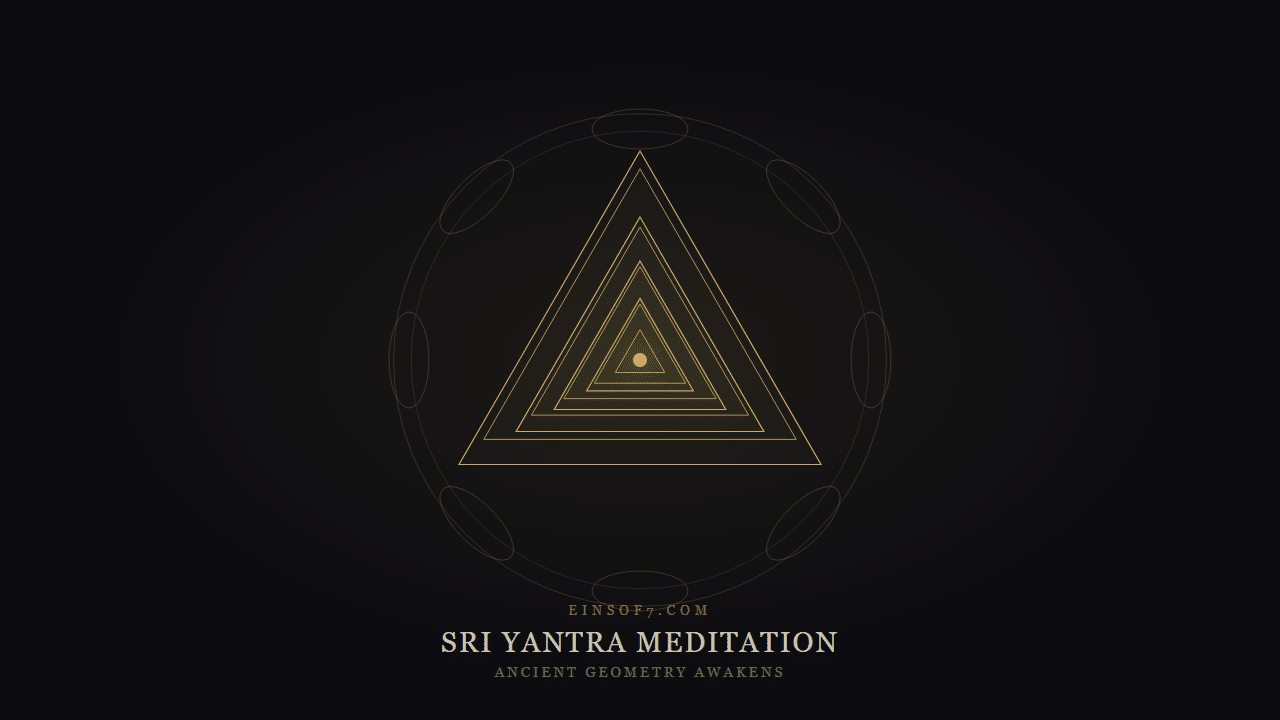
You sit before a complex geometric diagram. Nine interlocking triangles form a star against a plain background. This image is not a puzzle to solve. It is a map meant to focus an unruly mind. The practice of sri yantra meditation uses this specific geometry to anchor your attention. A wandering focus suddenly finds a center.
Vedic and Tantric traditions call this the mother of all yantras. The word itself translates to instrument or machine. The visual tool shifts perception away from scattered thoughts. Four upward triangles represent masculine stillness. Five downward triangles represent feminine creative force. They meet at a single central dot called the bindu. This tiny point signifies the origin of both the universe and your own awareness.
Staring at interlaced lines might seem overly simple. Yet gazing practices exist across many cultures for a clear reason. The eyes provide a direct pathway to the nervous system. When tracing the forty-three smaller triangles, the mind stops fighting itself. You are not trying to force strange psychic powers awake. You are simply training your brain to hold a single, unified state of consciousness.
Using this ancient instrument requires no specialized belief system. It requires only patience and a willingness to look closely. The geometry provides a physical anchor for an internal process. By learning how to engage with these shapes, the capacity for deep attention rebuilds itself. The center is already there, waiting for your gaze.
🏛️ Tantric Roots of the Shri Chakra
In a humid stone courtyard in Kerala, a priest drags a brass stylus across a copper plate. He carves nine intersecting lines with absolute precision. One slip ruins the geometry. This is the creation of a yantra. It is not art for display. It is a precise spiritual technology.
Traditions of Tantric Hinduism revere this specific design. The dense, layered shape has anchored meditation practices for centuries. Some lineages claim the symbol is thousands of years old. Modern historians trace its earliest physical evidence to medieval Indian texts. In his research on Tantric art, scholar Ajit Mookerjee documented how these specific proportions have been maintained across centuries of reproduction.
Translating abstract theology into a tangible focal point, the symbol represents a map of cosmic evolution. The word sri means wealth or abundance. Yantra translates roughly to instrument or machine. Together, they form a functional tool for spiritual wealth. These are deeply established vedic meditation tools used to bypass the analytical mind.
The diagram maps primary cosmic forces. It displays the union of shiva and shakti energies. Four upward-pointing triangles represent the masculine principle of stillness. Five downward-pointing triangles embody divine feminine consciousness. These primary shapes interlock to form 43 smaller triangles.
Radiating from a single dot, the entire structure centers on the bindu. It represents the unmanifested state of the universe. It is the silent origin of all creation. This rich shri chakra symbolism gave early meditators a visual anchor. It provided a map to guide consciousness back to its source.
How does a flat drawing quiet a racing mind?
🌙 Sri Yantra Geometry as an Anchor
Complex geometry is hard for the brain to ignore. When eyes lock onto this pattern, the visual cortex processes symmetry, depth, and proportion all at once – and that intense workload leaves almost no room for mental chatter. The mind usually jumps relentlessly from thought to thought. This visual tool interrupts that restless pattern. The intersecting lines trap wandering attention.
The sri yantra sacred geometry provides structured cognitive load. Because this intense visual processing occupies so much of the brain’s bandwidth, the internal monologue naturally quiets down. It’s not suppression. It’s displacement.
The specific geometry manifests as a visual representation of aum. The cosmic sound of creation takes a visible form here. Sound and shape share identical frequencies in Vedic traditions. Gazing at the yantra absorbs the mind entirely. It pulls focus away from external physical distractions.
Deliberate use of shape connects to a wider history of ancient symbols designed to alter human perception. Humans have long used precise geometry to command attention. The sharp angles demand absolute presence.
Certain lineages emphasize open eye meditation benefits when using this tool. Keeping the eyes open prevents the usual drift into sleepiness. It bridges the gap between inner stillness and outer reality. A few esoteric traditions even link this intense gazing to pineal gland activation meditation, suggesting the optical pressure stimulates deeper neurological states.
The pattern stops the mind. The eyes lock. The noise fades.
🧘 Tratakum Gazing: The Visual Journey
The technique is called tratakum gazing meditation. It requires a physical copy of the yantra – a printed image or a metal etching both work. The lines need to be sharp and clear. Blurry edges frustrate the eyes and scatter your attention before you even settle in.
Prop the yantra at eye level on a small table or altar. Sit roughly an arm’s length away. Soft but clear lighting matters more than people expect – harsh glare strains the eyes, dim light makes you squint. Keep your spine straight but not rigid. Rest your hands in your lap, take three slow breaths, let your shoulders drop and your jaw release.
Let your eyes open at their natural width without forcing them wide. Direct your gaze to the outermost boundary of the yantra – usually a square enclosure with four distinct “doors.” Trace this outer perimeter slowly. You’re acknowledging the edge between the ordinary room and the geometry you’re about to enter.
Move your vision inward to the outer circular rings. The lotus petal motif there represents the unfolding of awareness. Follow the circle all the way around. Then let your gaze step deeper into the dense maze of interlocking triangles at the center.
Don’t try to count them. Don’t analyze the intersections. Just let your eyes rest on the network of lines. The image will likely start playing tricks – triangles popping forward, receding, shifting depth. Let that happen without trying to manage it.
Draw your focus slowly toward the absolute center. Find the tiny central dot. Lock your gaze onto it. Let the rest of the geometry blur into your peripheral vision. Keep your eyes relaxed but fixed. This is your anchor now.
Thoughts will come. They always do. When you drift, return your gaze to the bindu. No frustration required. The center is still there waiting.
Hold the gaze for five to ten minutes. Your eyes may water slightly. You might feel mild pressure behind your forehead – that’s a normal physical response to intense visual focus. Blink as little as you comfortably can. Let the image settle into your retinas.
When you’re ready to finish, close your eyes slowly. Keep them closed for a few quiet minutes. You’ll likely see an afterimage of the yantra glowing internally. Watch it until it fades into pure darkness. Take one breath and open your eyes.
🌿 Navigating the 43 Triangles
The practice adapts naturally to different experience levels. Those new to the technique often skip the outer geometry entirely, sitting down to stare directly at the central bindu. This single-pointed focus builds foundational concentration quickly. It trains the eyes to remain still. It teaches the mind to tolerate silence without agitation. This direct approach works well for quick mental resets.
A more analytical method involves deliberately tracing the 43 triangles meaning. You use your eyes to follow specific pathways through the maze. You might trace all the upward masculine triangles first. Then you trace the downward feminine triangles. This active visual tracking requires immense mental stamina. It leaves absolutely no room for stray thoughts. The sheer complexity of the geometric pathways absorbs the entire conscious mind. This variation suits those who struggle with passive gazing.
Over time, experienced meditators internalize the entire structure. They gaze at the physical yantra just long enough to capture the afterimage. Then they close their eyes completely. They project the glowing geometric shape into their own mental space. They try to hold the complex star pattern in their mind’s eye. When the internal image dissolves or loses its sharp edges, they open their eyes and look at the physical yantra to recharge the visual impression. This bridges the gap between external gazing and pure internal visualization.
Certain lineages adapt these techniques into a yantra manifestation practice. They focus on the outward expansion of the symbol. Instead of moving inward to the center, they start at the bindu. They mentally push their intention outward through the expanding triangles. They visualize their focus radiating through the lotus petals and out the four doors. This active visualization shifts the tone of the meditation entirely. It moves from quiet withdrawal to deliberate outward projection.
💡 Sustaining the Bindu in Chaos
Taking this meditation off the cushion requires a shift in perspective. The goal is not to hallucinate geometric shapes in daily life. The goal is to carry the feeling of the central anchor. The physical practice trains you to find a still point amid complexity. Daily life provides the relentless complexity. The challenge lies in providing the still point.
Notice when your attention becomes scattered during the day. This scattered state mirrors the chaotic outer edges of the yantra. When you feel overwhelmed, recall the image of the bindu. Close your eyes for ten seconds. Visualize that single, dense point of unwavering focus. Use the memory of the geometry to pull your scattered energy inward.
Eye strain remains the most common physical complaint during formal practice. People sometimes stare too intensely. They forget to blink. The gaze should be steady but soft. If your eyes burn painfully, close them and rest. The practice should challenge your focus, not damage your vision.
The mind also resists being confined to a single dot. It will generate urgent physical itches. It will conjure forgotten errands and sudden anxieties. Recognize these disruptions as standard mental protests. They are the friction of the mind slowing down. Return your eyes to the center point without frustration.
Progress reveals itself quietly. The optical illusions may stabilize during practice. The triangles may stop flickering and hold a steady three-dimensional shape. You might find the afterimage lasting much longer behind closed eyes. Off the cushion, you might notice a longer pause before reacting to stress. The geometry slowly trains the nervous system to hold its ground. The center slowly becomes a habit.
🧘 The Lived Experience of the Yantra
Sitting with the Sri Yantra feels less like looking at an image and more like entering a quiet room. At first, the dense network of lines blurs and the eyes protest the sharp angles. The mind throws up its usual resistance, urging you to look away or check the time. As the gaze softens, the geometric weight of the design takes over. The peripheral vision dims slightly, leaving only the interlocking triangles in sharp relief. A physical sensation often settles right behind the forehead – a light, steady pressure that feels grounding rather than painful. The chaotic hum of the day does not disappear completely, but it recedes into the background. You find yourself resting entirely in the present moment, anchored by a simple dot that somehow holds the weight of your entire attention.
The Center Remains
You blink slowly, and the sharp intersecting lines finally vanish from your immediate field of vision. Yet the complex shape often lingers vividly behind your closed eyelids for several quiet, uninterrupted moments. The physical copper plate or printed paper has already finished its job. Now the geometric structure exists solely within you.
Daily life demands that we constantly project our awareness outward into a fractured, demanding physical environment. Modern routines scatter human focus across endless digital spaces and rapid interactions with other people. The sri yantra reverses this deep cognitive exhaustion by demanding absolute visual presence from the tired practitioner. We fracture our attention just to survive.
Tracing those interlaced triangles gives the visual cortex heavy spatial work to process during the quiet practice. This intense optical demand naturally forces the restless internal monologue to drop away without any conscious mental effort. Relief arrives when the tired brain finally stops fighting its own chaotic momentum and finds a stable resting point. The center holds its shape inside you.
❓ Frequently Asked Questions
Why is the Sri Yantra considered so powerful in meditation?
The specific geometric arrangement forces the brain’s visual cortex to process complex spatial relationships, which naturally suppresses internal mental chatter. By demanding intense optical focus, it bypasses the analytical mind and induces a state of deep concentration faster than closed-eye practices.
How do you activate a Shree Yantra at home?
Activation relies on consistent visual engagement rather than complex rituals. Placing the diagram at eye level in a softly lit, dedicated space establishes a physical anchor for your daily practice. The true activation occurs when your nervous system begins to associate that specific geometry with immediate mental stillness.
What are the primary benefits of Sri Yantra meditation?
Regular practice builds immense visual and cognitive stamina, making it easier to hold concentration during chaotic daily situations. Over time, the eyes learn to remain steady and the mind develops a higher tolerance for silence, reducing the baseline level of stress and reactivity.
For a broader understanding of this symbolic tradition, explore our complete guide to Ancient Symbols: The Hidden Power That Drives Us.
Explore Related Topics

Dalton Treviso is an independent researcher and writer exploring archetypes, Jungian psychology, and mythological symbolism. His work focuses on how ancient philosophical traditions and symbolic systems illuminate the hidden structures of the human psyche.
Drawing on Jungian psychology, Stoic thought, and comparative mythology, Dalton examines how the inner patterns we carry shape perception, conflict, and transformation.
Through EINSOF7, he writes about the symbolic architecture of the mind — exploring how myths, archetypes, and philosophical traditions act as both mirror and map for psychological depth and self-understanding.
Areas of study: Jungian archetypes, animal symbolism, dream symbolism, mythological figures, and ancient symbolic traditions.