
This article is part of our Sacred Geometry series. Read the full guide: Sacred Geometry: The Hidden Blueprint of Creation
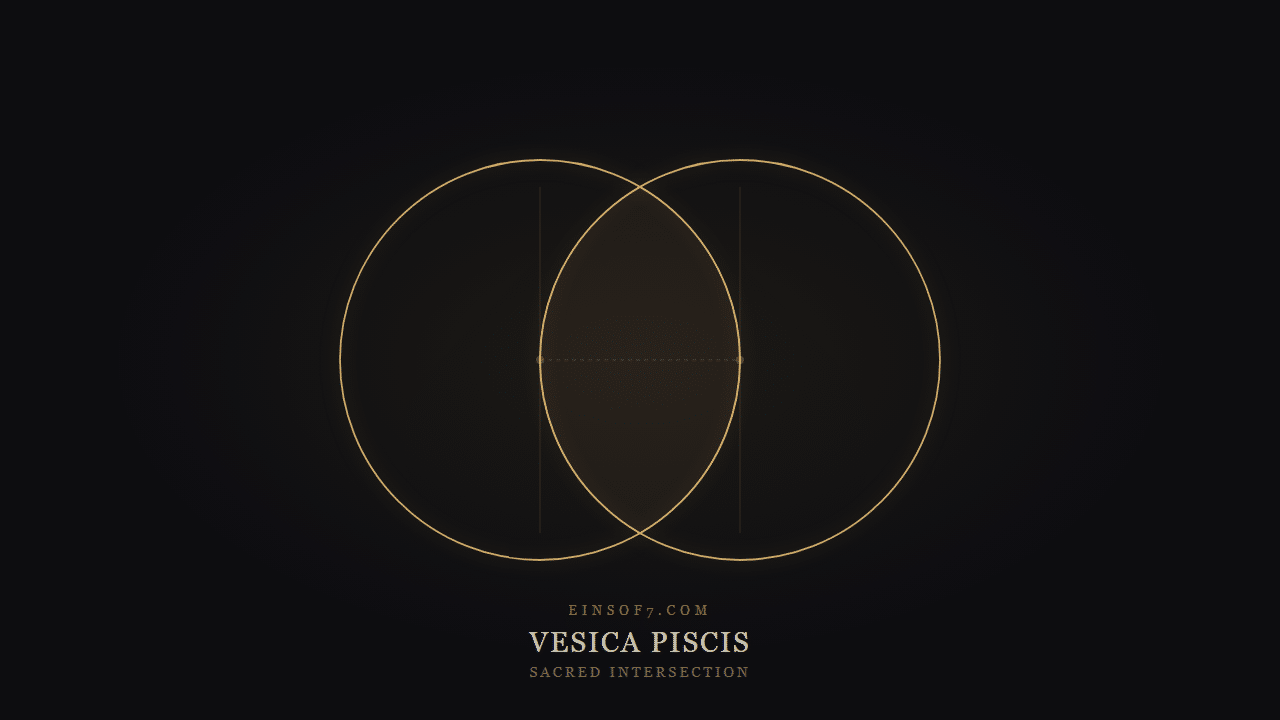
Stick a compass point into a blank page. Draw a circle. If you move the metal point to the edge and draw another matching circle, the two shapes will overlap perfectly. That almond space in the middle holds the vesica piscis meaning. It’s the starting point for almost everything in sacred geometry. Math is cold. But here, the geometry feels completely alive. This overlap demands every bit of your attention.
Euclid used this shape to build his first mathematical proofs. Secret groups later turned it into a hidden code. But ancient cultures were there first, viewing the shape as a universal birth canal. The real power of the symbol comes from a simple visual tension. This is the striking image of two separate, autonomous spheres that somehow find a way to share the exact same center.
Psychologists see this overlap as a map of your internal world. We are often torn. Your logical mind wants safety and a predictable routine. On the other hand, your unconscious side pushes for something wilder and less defined. The soul needs a place to stand between these two extremes.
Carl Jung called this shared space the mandorla. This isn’t a place for easy answers. It’s a high-pressure zone where you’re forced to change. When you hold two opposing ideas at the same time, a third reality starts to grow. This tension is what actually transforms a person.
This geometric sketch acts as a doorway. You only cross it when you stop trying to pick a side. Most people spend their whole lives trying to be just one thing. But real growth happens when you learn to occupy that shared middle ground with confidence.
📐 The Compass of Alexandria: Euclid and Vesica Piscis Meaning
Imagine Euclid in the Library of Alexandria around 300 BCE. He unrolls a fresh papyrus and grips a bronze compass while sitting in the quiet halls of the ancient world. He needs a perfect starting point to prove how geometry works. He places the compass point and draws a circle, then moves the tip to the edge to draw another. These two circles overlap perfectly. This simple shape is the vesica piscis – the first step in Euclid’s Elements. From this almond-shaped space, he builds the first equilateral triangle. The math here is exact.
Archimedes of Syracuse took these ideas even further a few centuries later. He studied how the inner dimensions of that overlap worked. In his work on measuring circles, he used this shape to find the square root of three. Author Robert Lawlor calls this shape the womb of the square roots of two, three, and five. The height divided by the width is exactly 1.732 – what you know as the root three ratio. These core numbers help generate the Golden and Silver ratios that define the way the natural world builds itself from the ground up. They show up when crystals grow or when light moves through space. This geometry is the engine behind how everything fits together.
Drawing it yourself makes the logic clear. You feel the metal tip press into the paper. You pull the pencil around in a steady arc until the line meets itself. That’s one circle. To make the next one, you place the point anywhere on that first line and draw another circle of the exact same size. This creates an almond shape in the middle that has to be there – it isn’t a random choice. It’s a law of how space works. Every shape you can imagine starts with this first division. Without this overlap, geometry just stops at a single dot.
🌊 Atargatis and the Cosmic Mother: Ancient Vesica Piscis Meaning
Ancient cultures saw this shape as a biological mirror long before Greek math entered the picture. It’s a pointed oval that mimics a vulva. This makes it a lasting symbol for the divine feminine across many continents.
People in northern Syria worshipped Atargatis, a water goddess who supposedly turned into a powerful fish, representing the fertile, life-giving waters that ancient people believed were the source of all existence. You’ll find her geometric signature in the vesica piscis. Her temples used this motif everywhere. Priests kept pools of fish while carvers etched the shape into stone.
India’s Vedic tradition uses this same geometry for the Yoni, representing the goddess Shakti. It’s the source of everything – a primordial womb for the entire universe. The place where the circles overlap shows the meeting of Shiva and Shakti, the moment consciousness and energy combine to bring the physical world into being. Without this union, the universe just doesn’t happen. Taoists see something similar in the way yin and yang swirl. That tension creates the Middle Way that Lao Tzu described.
This link to birth is everywhere. Most historians see the shape as a universal womb – the gate where energy becomes physical reality. Think about a single circle. It’s whole and complete, but it’s also stuck. You need a second circle to create friction. The introduction of a second circle forces a tear in that original perfection, proving that creation requires a certain kind of tension. But creation isn’t always peaceful. It’s a forceful split where one thing becomes two.
Northern European pagans used this form too. You can find intersecting circles in old Celtic stone carvings that marked spots for fertility and good harvests. Whether you look at the complex math or the ancient mythology, the conclusion is the same – this specific overlap represents the origin point of all generated forms in our world.
🌙 The Mandorla: A Doorway to Vesica Piscis Meaning
Art historians call this almond shape a mandorla. It’s the Italian word for almond, but the meaning goes deeper than snacks. Think of it as a portal. When you walk through a medieval European cathedral, look up at the stone carvings above the doors. You’ll see Christ framed inside this pointed oval. This isn’t just a design choice. The left circle is the divine sphere while the right circle represents our human world, making the mandorla the narrow space where both exist at the same time. Christ steps out of this almond portal to cross from eternity into our time.
Early Christians used this geometry as a survival tactic. During Roman persecution, the shape served as a secret code. Two quick arcs in the dirt formed a fish. One person drew the first curve, and a stranger drew the second to confirm they shared the same faith – a simple act that proved they were on the same side. This is the root of the Ichthys, though we call it the Jesus fish now. Back then, it was a tool for secrecy that helped people find safe harbors in a world that wanted them gone.
And this shape isn’t just a Western thing. Eastern artists carved the same frame around the Buddha. You’ll find these almond halos in ancient Indian and Chinese Buddhist art as well, marking divine figures as mediators between the celestial and the human. The geometry crossed every cultural boundary because the idea it represents is universal.
⚖️ The Tension of the Center: Pythagorean Mysticism and Vesica Piscis Meaning
The ancient Greeks didn’t just count numbers – they saw them as living principles. The Pythagoreans treated geometry as a spiritual path where they believed every shape possessed its own distinct and living moral weight. Think of a single circle as the Monad. This represents the undivided mind of a creator before anything else existed. When you add a second circle, you get the Dyad. This isn’t just math. It’s the birth of “otherness.” The vesica piscis sits right in that tension between two forces. It’s the moment unity splits.
The vesica piscis represents a “Third Way” for your own experience. It’s a mental state where you stop being a victim of your own inner conflicts. What’s interesting is how this relates to the Transcendent Function – the consciousness that shows up when you refuse to ignore one side of a hard choice. It’s the mediator inside you that looks at both your light and your dark without flinching or trying to fix the result. Wholeness doesn’t mean you’re perfect. It means you’re big enough to hold your own contradictions.
But this tension is where things grow. If you keep drawing circles from these intersections, patterns appear. Six-pointed stars emerge. The Flower of Life builds outward, one overlap at a time. The geometry generates itself from this single act of division, suggesting that creation is not a one-time event but a continuous unfolding from the same original tension.
🔭 The Architecture of Light: Scientific Vesica Piscis Meaning
Ancient thinkers had a hunch that modern physics now backs up with hard data. This shape shows up in the basic makeup of our world. It’s right there in electromagnetic fields. When two electrons release waves together, their fields overlap to create this specific pattern. Energy moves through a vacuum according to this geometry, which acts as a sort of invisible map for light and heat that keeps the whole system moving.
Look at the stars and you’ll find the same thing. Huge nebulae in deep space often take the shape of glowing mandorlas. This happens when two massive clouds of gas crash into each other in the dark, creating a high-pressure zone where gravity takes over and ignites new stars. We used to call it a cosmic womb, and it turns out that wasn’t just poetic fluff. It’s a physical reality.
Some people think this shape defines the link between how we hear sound and how we see light. The math actually mirrors the speeds of these basic forces. Ancient mystics and modern scientists are basically studying the same blueprint from different angles, and it’s rare to see that kind of agreement across such different fields of thought. These circles explain how reality hangs together.
🌑 The Shadow of the Dyad: Conflict and Vesica Piscis Meaning
The pattern of overlapping circles hides a darker side. That second circle ruins the quiet peace of the first. Mathematically, this Dyad brings separation. It’s the root of every human fight. When one identity splits into two groups, they almost always start competing for resources or dominance. The vesica piscis marks the line where these forces hit each other. That space isn’t always about birth or creation. Sometimes it’s a war zone.
Ancient stories warned about this division. This gap between two spheres can feel like a crushing vice. When two belief systems touch, the overlap becomes a battleground. The mandorla represents the heavy pressure of holding two different worldviews at once while trying to find a common ground that doesn’t exist yet. Most people can’t stand the tension of a paradox for very long. They want the safety of a single, lonely circle. A circle doesn’t ask you to change.
The problem is, running back to a single circle is just ideological hiding. You’re refusing to deal with the friction of someone else. The real shadow here is the choice to stay out of the overlap. We see this in politics all the time. Groups lock themselves inside their own lines and stay there. While geometry shows us that staying in an isolated circle kills the chance for anything new to grow, the actual intersection requires you to sit with the deep discomfort of being wrong. The middle is volatile.
💡 The Venn Diagram: Modern Vesica Piscis Meaning
We still use this shape. You probably call it something else. Venn diagrams usually show up in corporate slide decks or logic puzzles. John Venn brought these overlapping circles into the mainstream back in the late nineteenth century to explain set theory, but the way our minds handle the diagram hasn’t changed since ancient times. It forces you to find the shared space between two separate categories. It makes you look for the middle.
Psychologists argue that our minds work in a similar way. You deal with opposing forces every day. You want to be close to people while also wanting your own space. You carry conscious goals and hidden parts of yourself at the same time, which creates a constant internal pull. Your brain hates this friction. It wants to pick a side and win. The vesica piscis suggests a different path. It makes you stay in that uncomfortable overlap. You have to handle the contradiction.
Here’s the thing: using this wisdom means finding your two circles – maybe one is your need for safety and the other is your drive to grow. You focus on the narrow space where they cross over. This isn’t about finding a middle ground. It’s about finding a higher ground that only exists because of the tension.
This is about how you make decisions. When you feel stuck between two choices, look for a third option. This secret path only appears when the first two options collide. It’s a practice of staying calm while the world pulls you in two different directions at once, forcing you to remain centered in the storm. You don’t give in to one side or the other. Instead, you let the pressure build until it makes you stronger.
The silence between heartbeats is where the almond shape opens up. It isn’t a puzzle for you to solve. It’s a feeling you live in. When your mind stops jumping back and forth between this and that, you find a stillness that isn’t one side or the other. That is the secret. This geometry shows how “neither” becomes “both.” You are watching light come from the friction of the dark. It’s an eye looking at itself.
We focus on the circles, but the gap is what matters. The gap is the only part that isn’t just a line on a page. It’s an actual space. Your soul sees itself there. It isn’t a static picture. You are looking at a moving intersection of everything you are capable of becoming. This is the narrow gate the mystics talked about. You can’t get through if you are carrying the heavy weight of being right all the time. The individual disappears into the connection. The almond is a bridge that burns behind you. The only way left to go is in.
👁️ The Internal Geometry of Vesica Piscis Meaning
Ancient math usually feels like a set of cold rules. But it isn’t. This overlapping shape actually maps out your deepest internal battles. Imagine drawing two circles to represent the opposing forces in your life. Logic pulls you one way while raw emotion drags you another. You want to feel safe, but you also want to risk it all. Most people try to force a choice because picking a side feels better than standing in the middle of a fight.
Euclid used this overlap as the base for mathematical truth. And it’s where you start growing up. Standing in that center requires you to sit with a lot of heavy discomfort. The spot where two conflicting truths hit each other is never a quiet place. It forces you to hold both realities at once without trying to find some weak compromise that makes you feel safe. This friction is what creates something new. Something unique grows inside that narrow, pressurized gap. You can’t skip the tension if you want to change how you think and act in the world. The overlap asks you to give up certainty.
Now you’re just looking at the math of your own divided nature. A metal tip holds its ground on the page. Two lines cross. The tight space between them is waiting for you to fill it with whatever meaning you find in the middle of the struggle.
❓ Frequently Asked Questions
What is the spiritual significance of the vesica piscis?
Think of it as a bridge. It shows exactly where spirit meets matter. You see two distinct circles overlapping to create a shared third space, which represents the moment creation actually happens. This central almond shape acts as a doorway for new life to enter our physical world.
Why are there two intertwined circles in this symbol?
These circles represent the two sides of existence. One stands for pure unity. The other stands for the world of form and relationships that you navigate every day. But reality doesn’t exist in a vacuum. It lives in the friction of connection between these two forces.
How does the vesica piscis relate to Christianity?
You’ll often see this shape surrounding figures like Christ or the Virgin Mary in traditional art. It’s called a mandorla. The shape marks them as a mediator who stands between heaven and earth. It also gave birth to the Ichthys – the famous fish symbol early Christians used to identify each other while hiding from the Roman authorities during periods of heavy persecution.

Dalton Treviso is an independent researcher and writer exploring archetypes, Jungian psychology, and mythological symbolism. His work focuses on how ancient philosophical traditions and symbolic systems illuminate the hidden structures of the human psyche.
Drawing on Jungian psychology, Stoic thought, and comparative mythology, Dalton examines how the inner patterns we carry shape perception, conflict, and transformation.
Through EINSOF7, he writes about the symbolic architecture of the mind — exploring how myths, archetypes, and philosophical traditions act as both mirror and map for psychological depth and self-understanding.
Areas of study: Jungian archetypes, animal symbolism, dream symbolism, mythological figures, and ancient symbolic traditions.