
This article is part of our Sacred Geometry series. Read the full guide: Why Sacred Geometry Awakens the Primal Mind
Imagine sitting down to trace a perfect circle on a piece of heavy paper. Your mind follows that curving graphite line as it closes the loop. This isn’t just looking at cool patterns on a screen – it’s a real discipline. Practicing sacred geometry meditation works because it gives your attention something solid to hold onto while the rest of the world feels like it is spinning out of control. It forces a frantic brain to slow down. Focus is hard.
You’ve probably seen these shapes used as decorations in modern yoga studios or sound baths. People sit inside pyramids and hope the room does the work for them. But mystics didn’t treat geometry as wallpaper. They understood that these specific ratios could act as a bridge between the messy physical world and the quiet clarity of the spirit. A triangle isn’t just a shape – it’s a tool to organize your internal chaos. It works.
Visualizing these exact proportions shifts your internal gears. You focus hard on the lines, then you let go into a sudden, total relaxation. This rhythm creates a stillness that most people struggle to find through traditional breathing alone. Nature builds galaxies and pinecones using these same mathematical constants, so it makes sense to use that same logic to structure your own awareness. You’re just building a home for your thoughts. It stays steady.
You can’t just wait for a feeling of calm to wash over you. Passive listening can only take you so far. You need to build a structured space where quiet can actually survive the noise of your day. Think of these crossing lines as a reliable map for your awareness. Every intersection is a place to rest. If you follow the coordinates left behind by ancient teachers, you’ll find that the mind settles much faster than you expected.
🏛️ Pythagorean Geometry for Shaping Consciousness
Pythagorean geometry wasn’t just math for the Greeks. It was a way to touch the world’s hidden order. Imagine a philosopher in Croton smoothing a patch of sand. He presses an iron point down. With a steady hand and a bronze compass, he sweeps out a perfect circle. You can’t do this without being fully present. It’s a physical act that demands your total attention.
These thinkers knew your mind reflects whatever you focus on. Nature feels chaotic, but geometry is different. It’s stable. If you stare at a perfect square, your mind starts to feel that same stability. The golden ratio spiritual meaning was actually quite practical back then because it gave students a flawless object to hold in their awareness. You aren’t just looking at a shape. You’re borrowing its balance.
The problem is, most of us have minds that wander constantly. Geometry fixes this. Don’t think of these shapes as magic charms. Think of them as tuning forks for your focus. A geometric form gives you immediate visual boundaries. You learn to stay within the lines. This old method is the foundation for modern sacred geometry meditation. It turns abstract math into something you can actually feel.
🧠 Using Math as a Meditation Anchor
You’ve probably wondered how a simple drawing can settle a racing heart. It works because patterns give your brain something specific to do. Your rational mind loves to spin in circles when you’re stressed, trying to think your way out of feelings. It’s exhausting. But when you focus on tracing a complex design, you break that cycle.
Your visual cortex takes over. Your inner monologue finally shuts up. Stillness follows.
Alchemy sacred geometry is all about this mental shift. You’re constantly moving between sharp focus and soft, relaxed observation. One minute you’re concentrating hard on drawing a perfect line, and the next you’re just sitting back to look at the whole shape. This rhythm creates a deep sense of quiet inside you. Honestly, it feels like the room finally stopped spinning.
Sound does the same thing. Harmonic meditation frequencies act like audio versions of these shapes. Some people use 432 Hz tuning because it mirrors the math found in nature, creating a sense of balance that matches the visual patterns you see on the page. Solfeggio frequencies healing works the same way. It uses math to tell your nervous system that it’s okay to relax. Patterns give your mind a place to rest.
🧭 Tracing the Seed of Life in Meditation
Sacred geometry meditation isn’t just a mental exercise. It’s a physical discipline. You’ll need a metal drawing compass, a sharp pencil, and some heavy paper. Find a quiet desk with decent lighting and clear away the clutter so your physical environment reflects the inner order you want to create. Sit with your spine straight. Keep your feet flat on the floor.
Place the paper directly in front of you. Take three slow breaths to settle your nerves. Press the metal point of the compass into the center of the page. Don’t push too hard. Just anchor it. Widen the compass legs to a distance that feels right – about two inches works well.
Hold the top of the compass between your thumb and index finger. Start drawing your first circle. Roll the tool slowly. You’ll feel the paper resisting the graphite as you guide the pencil across the page with a steady hand and a quiet mind. Keep your wrist stiff and let the motion come from your shoulder. Watch the line. If your mind drifts, come back to the physical drag of the pencil.
Complete the circle. Breathe out when the line meets its start. This circle represents unity and the birth of your focus. Now, lift the compass. Keep the width exactly the same and place the metal point anywhere on the line you just drew.
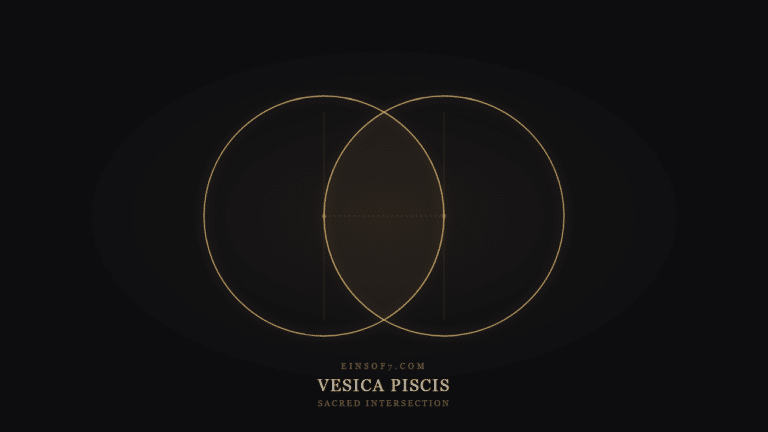
Draw a second circle. It should pass right through the center of your first one. The overlapping space in the middle looks like an almond. This shape is the vesica piscis. Stop drawing for a second. Your eyes naturally want to find the center. Let your gaze rest inside that central almond.
Place the compass point at one of the intersections where the two circles cross. Draw a third circle. It’ll pass through the center of the original circle.
Keep this pattern going. Move the point to the next intersection along the edge of your first circle and draw again. You’ll eventually draw six circles around the central one. Don’t rush. You’ll probably feel some impatience rising as you work through the repetitive motions of the pattern, but you must keep going. Acknowledge that feeling and then slow your hand down even more.
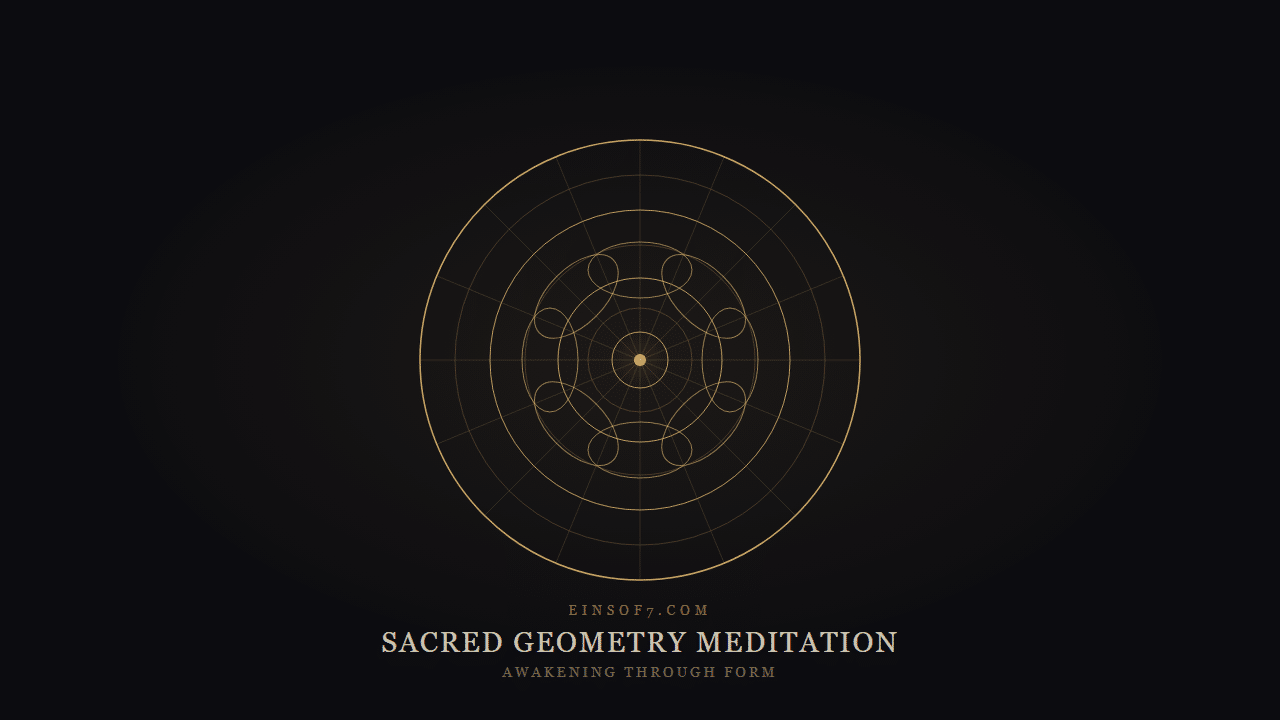
When you finish the last circle, a six-petaled flower appears. This is the Seed of Life. Set your compass down.
Place your hands flat on the desk. Shift from active focus to relaxed observation. Let your eyes soften. Don’t stare at any single line. Look at the whole pattern. Notice the symmetry and the empty spaces. Hold this soft gaze for five minutes. Breathe naturally. Let the order of the image anchor your thoughts.
📐 Deepening the Sacred Geometric Focus
Your focus grows as you get better at concentrating. Start small. Look for shapes in the world around you, like a pinecone or a fallen leaf. Trace the spirals with your eyes and see how the veins branch out from the center. This symmetry often links back to the wider history of animal symbolism found in different cultures, proving that math isn’t just a cold abstraction but a living part of our world. It shows how math lives in nature.
Cultivating Inner Space with Platonic Solids
When drawing circles feels easy, try building shapes inside your mind. Forget the paper. Close your eyes and see a tetrahedron. It’s just a pyramid with a triangular base. Imagine it floating in the dark. Make the edges glow with a soft light.
Turn the shape over slowly. Look at it from every angle. This takes a lot of mental energy. The shape will probably fall apart at first, but you shouldn’t let that stop you from simply starting over and trying to hold the image for a few seconds longer each time.
Try harder shapes next. Picture a perfect cube. Then try an octahedron, which looks like two pyramids joined at the bottom. Holding these 3D objects in your head builds real mental strength because it forces your brain to process spatial relationships without any help from your physical eyes. It cuts through the noise. It demands everything.
Advanced Lineages of Geometric Focus
Some people use Metatron’s cube for deeper work. This shape hides all five Platonic solids inside its lines. You need a ruler and plenty of patience to draw this one. You have to track dozens of points at once. If your mind drifts for a second, the whole drawing goes off because the lines won’t meet where they are supposed to, and you’ll have to start the entire process again. It keeps you right in the moment.
Eastern traditions use the Sri Yantra for the same kind of training. This old design has nine triangles that all point toward the middle. Following the lines draws your eyes inward. It’s a funnel for your attention. Mandala meditation works the same way. You move from the busy edges toward a quiet center.
Modern teachers often use shapes to balance energy. They place geometric forms at specific points in the body. You could imagine a red square at the base of your spine to feel grounded. Or you might see a blue triangle at your throat. These shapes help you map out how you feel inside.
💡 Grounding the Angles of Sacred Geometry in Daily Life
You don’t need a fancy setup to start. Geometry works best when you weave it into your normal day. Keep a small notebook and a compass near your laptop. Draw one perfect circle. This simple movement settles your nerves. When the pressure of a deadline starts to build and your heart begins to race, taking those few minutes to focus on a single shape can completely change your perspective. It pulls your brain away from stress and back toward focus.
Maybe you don’t have tools handy. That’s fine. Use your breath to trace shapes in the air. Imagine a triangle. Inhale while your mind climbs the left side. Pause at the top. Exhale as you slide down the right side and rest at the bottom base. By visualizing these lines and following them with your lungs, you create a structured internal space that helps quiet the noise of a busy room. This pattern gives your anxiety a physical boundary to live within.
Look for shapes in the buildings around you. Some spaces use geometry on purpose to change how you feel. The Pyramid Yoga Center in the Gulf of Thailand uses a literal pyramid structure and caps it with gold to help change the way the environment feels. You can do this at home on a smaller scale. Find a square window. Sit in front of it. Use those sharp right angles to steady your eyes during your morning sit.
You’ll get frustrated. Pencils snap. Your compass will definitely slip. The final drawing might look like a messy, lopsided disaster. Your logical brain will judge the result and tell you that you failed.
But here’s the thing. That mess is actually the point. The goal isn’t making a masterpiece. You’re trying to align yourself with a sense of order. When the needle slips, just breathe. Erase the mistake. Put the point back down. Start over. Instead of getting angry that the circle isn’t round or the lines don’t meet, you learn to treat the error as just another part of the process. That specific moment of starting over is where the real work happens. It teaches you how to handle life’s interruptions with grace.
🧭 Experiencing the Geometric Anchor
Working with these proportions feels different than just sitting still. It’s like stepping into a quiet room. You feel the graphite drag against the heavy paper, and that physical resistance settles your nerves instantly. Suddenly, the day’s noise disappears into one curving line.
Your brain stops chewing on old problems. Instead, it focuses on the gap between the compass point and the arc you’re drawing. Your breath follows your hand. You’re giving a tired mind a real boundary where it doesn’t have to invent its own structure but can simply lean against the reliable angles of the page. It works.
The Internal Architecture of Geometric Meditation
You lift the metal compass from the paper. Fine graphite dust settles on the precise curves you just finished drawing by hand. Your breathing is slower now. It’s much better than when you first sat down at the desk. An anxious brain doesn’t quiet its own frantic spinning through sheer force. It needs a structured container to set down its heavy daily burdens. Working with a pencil provides that physical anchor.
Early philosophers understood this truth. They didn’t stare at circles and wait for a wave of peace to hit them. Instead, they used mathematical ratios to build their own internal stillness. Tracing these ancient proportions forces your wandering thoughts into a predictable rhythm that blocks out the noise of a chaotic afternoon. The world fades away. You stop fighting your mind. Following the curve becomes everything.
Eventually, you clear the workspace. The geometric shape stays on the desk. But the clarity remains in your chest. You built a stable room using nothing but your own deliberate attention. Geometry is a map for navigating your internal weather. These intersecting lines show your tired mind exactly where to stand.
❓ Frequently Asked Questions
What are the best sacred geometry symbols for beginners to draw?
Start with the Seed of Life or the simple vesica piscis. They’re great because you only need basic compass skills to get them right. You’ll see symmetry emerge almost immediately. It’s satisfying. And it stops your mind from wandering. You might also like to look at animal symbolism if you want to understand how these same mathematical patterns show up in the natural world around us.
How does sacred geometry meditation differ from mindfulness?
Most mindfulness practices ask you to watch your thoughts pass by. Geometry takes a different path. It gives your brain a specific, spatial job to do. This active engagement shuts up the part of your brain that loves to talk, creating a sense of quiet that comes from focus rather than just sitting still. It isn’t passive.
Do I need special tools to practice geometric visualization?
You’ll want a metal compass and some thick paper for drawing. But for visualization? You don’t need a single thing. You can trace a triangle using the architectural features of the room you’re in right now to anchor your nervous system during a busy day. That simple action works anywhere.

Dalton Treviso is an independent researcher and writer exploring archetypes, Jungian psychology, and mythological symbolism. His work focuses on how ancient philosophical traditions and symbolic systems illuminate the hidden structures of the human psyche.
Drawing on Jungian psychology, Stoic thought, and comparative mythology, Dalton examines how the inner patterns we carry shape perception, conflict, and transformation.
Through EINSOF7, he writes about the symbolic architecture of the mind — exploring how myths, archetypes, and philosophical traditions act as both mirror and map for psychological depth and self-understanding.
Areas of study: Jungian archetypes, animal symbolism, dream symbolism, mythological figures, and ancient symbolic traditions.