This article is part of our Animal Symbolism series. Read the full guide: Why Animal Symbolism Awakens the Primal Mind
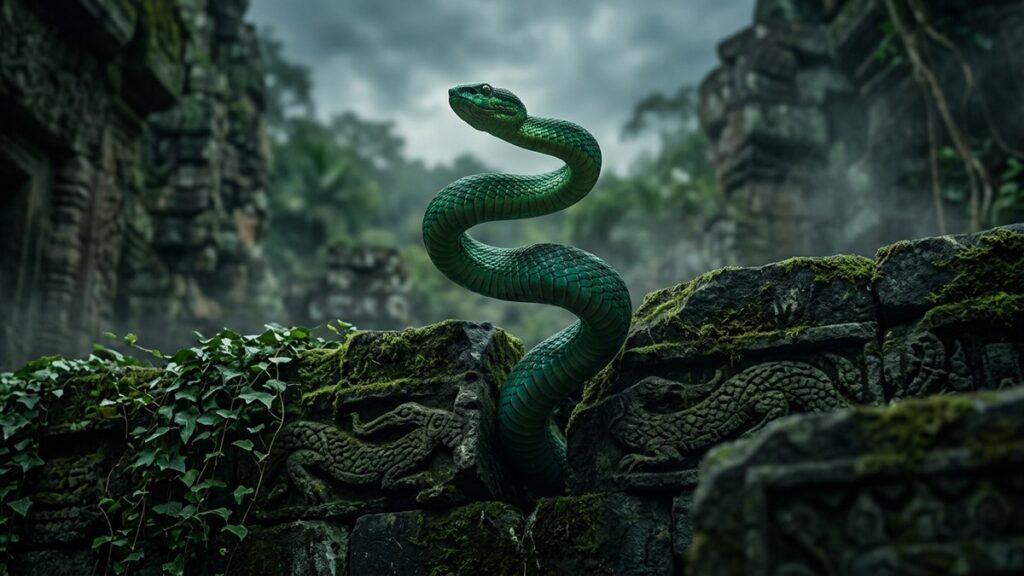
A creature rests dormant at the very base of the human spine. Ancient Vedic sages did not view this coiled entity as a poetic metaphor. Sacred texts describe a sleeping, highly volatile force named Kundalini. Waking suddenly, the unseen reptile moves upward with fierce, transformative heat to change the host. The true core of snake symbolism lies in this internal, biological drama.
Western minds often reduce the serpent to a simple villain or a classical monster to be slain. Older indigenous traditions treat the reptile entirely differently, viewing it as a vast, living spiritual system. They engage with the animal as an active, world-shaping creator. Across the Australian deserts, a massive Rainbow Serpent carved rivers into the dry red dirt. Meanwhile, Mesoamerican priests worshipped a feathered deity who physically bridged heavy earth and open sky.
Living painfully close to the underworld, the animal drags its belly across the dusty topsoil. Then, a quiet but profound biological miracle occurs in the dirt. The creature sheds its dead outer skin to emerge into the world entirely renewed. Witnessing this visceral act made the serpent a universal emblem of radical rebirth and healing. Even its venom carries the intense duality of deadly poison and miraculous cure.
Encounters with this coiled energy still happen today during sudden, painful life upheavals. Demanding total surrender, the archetype forces comfortable old identities completely away. The challenge is letting dead psychological layers fall quietly to the dirt. Beneath those discarded scales, hidden knowledge waits. Something raw, untested, and fiercely alive finally wakes up.
🏛️ Per-Wadjet and the First Serpent Oracle of the Nile
The Nile Delta is a vast, muddy expanse of life. Water channels weave through endless fields of tall, green papyrus. This fertile environment teemed with dangerous, unpredictable wildlife. Among these creatures, the cobra demanded the highest human respect.
A bite meant agonizing death. The venom acted fast. There was no escape.
Yet, the ancient Egyptians elevated this killer to divinity. Wadjet was the patron goddess of this expansive northern region, fiercely protective of the land and its people.
When Upper and Lower Egypt united, the symbolism evolved. Pharaohs adopted the “Two Ladies” as their royal insignia. Nekhbet the vulture represented the arid, mountainous south, while Wadjet the cobra represented the wet, fertile north. Together, they formed the ultimate symbol of unified political power. Artisans crafted the Uraeus divine insignia with astonishing, meticulous detail, using lapis lazuli and solid gold to form the hood. Worn directly on the pharaoh’s forehead, the golden snake rested exactly at the mystical third eye. The artifact signified ultimate cosmic dominion and piercing spiritual sight. The ruler possessed the deadly, striking power of the earth itself.
The serpent was not merely a silent, glittering emblem of kingship. It functioned as an active, vocal source of divine prophecy. Traveling to the city of Per-Wadjet centuries later, the Greek historian Herodotus recorded a thriving oracle dedicated to the goddess Leto—the Greek cultural equivalent of the Egyptian Wadjet. The temple complex housed massive, sacred serpents in dark chambers. Priests carefully interpreted their movements to predict the coming future. This particular Egyptian site held massive cultural influence, likely shaping later Greek oracle traditions across the Mediterranean. Long before the god Apollo claimed Delphi, the serpent spoke. The snake was the original, unfiltered voice of the earth.
But how did a creature bound to the dirt become an architect of the cosmos?
🌍 The Serpent as Earth Shaper Across Vast Horizons
The archetype slithers far beyond the borders of ancient Egypt. Across the Atlantic, a very similar reverence emerged in Mesoamerican worship of the mighty Quetzalcoatl. Monumental pyramids at Teotihuacan feature massive stone serpent heads projecting outward, surrounded by elaborate carved feathers. The heavy scales represented the dark, fertile, grounded earth, while the bright plumage belonged to the limitless, sunlit sky. Quetzalcoatl embodied the perfect union of cosmic opposites. As a creator god of immense cultural importance, he brought ancient wisdom, mathematics, and deep cyclical agricultural renewal.
In the harsh, red deserts of Australia, the story goes deeper. The Aboriginal Rainbow Serpent Dreamtime narrative describes a massive creator known by many sacred names across different language groups. Some call it the Wagyl, while others revere the Yingarna. Slithering across the barren, primordial earth, this immense being used its heavy, undulating body to carve deep valleys and vast rivers. Fresh water followed closely in its massive, winding wake. The landscape itself is the physical scar of its movement. Wherever the serpent stopped to rest, a vital waterhole formed.
African Vodun traditions revere a similar cosmic entity named Dan. A glorious rainbow serpent, Dan connects two worlds by physically bridging the massive gap between heaven and earth. He remains a fundamental force of continuous, vibrating cosmic creation. Followers believe his immense coils physically hold the universe together. If Dan were to uncoil, the world would instantly collapse.
Asian spiritual traditions recognize the creature as an internal force. Ancient texts describe the Kundalini energy resting tightly coiled at the base of the spine. When successfully activated, it moves upward with intense, burning heat, radically altering the consciousness of the dedicated spiritual practitioner. Vedic and Buddhist traditions also honor the naga water spirits. Guarding hidden treasures and sacred, flowing rivers, these powerful beings live in beautiful, sprawling sub-aquatic palaces below the mud. They control the seasonal monsoon rains and vital agricultural fertility. A clear pattern emerges from the serpent’s recurring role as a creator, anchoring the deep roots of animal symbolism across diverse cultures. The snake is never just a simple, biological animal. It is the very architecture of the living, breathing world.
🌙 Snake Venom, Medicine, and the Shedding of Skin
The physical reality of the snake dictates its heavy myth. Living permanently pressed against the cold, damp dirt, it vanishes quickly into dark, hidden burrows in the soil. Ancient Greeks viewed snakes as potent chthonic underworld symbols, believing serpents generated spontaneously from the rich, wet earth. The creature belonged entirely to Ge, the great Mother Earth. It was a native, untouchable resident of the dark below. Greek cremation amphoras often feature painted snakes guarding the dead, as the animal travels effortlessly between the living and the dead.
Biology offers another profound, inescapable metaphor for human observers. A snake physically outgrows its own tight exterior scales by rubbing its sensitive snout against rough, jagged stone. The old exterior cracks open and peels entirely backward. Emerging glistening and highly vulnerable, the creature is entirely renewed. The physical shedding of skin built the archetype of rebirth. The serpent conquers death by physically leaving its dead self behind. Ancient people watched this painful process with deep religious awe, believing the snake actually achieved literal physical immortality.
Then there is the urgent, terrifying matter of the bite. Snake venom duality presents a highly complex biological paradox. A single drop can easily paralyze the human nervous system, stopping the heart and shutting down the lungs within minutes. Yet, that exact same venom holds immense curative power. Ancient healers carefully used diluted venom to treat severe ailments. The fluid acts as both sudden death and a potent, life-saving antidote.
The Greek god of healing understood this delicate balance perfectly. Asklepios wrapped a single snake around his rough wooden staff after, legend claims, a serpent taught him the secret of resurrection. The reptile brought a healing herb to a dead companion. Observing this, Asklepios learned the ultimate, forbidden medical secret. His followers built massive healing temples at the city of Epidauros, where priests kept large, non-venomous snakes freely roaming the temple floors. The Rod of Asklepios remains the universal emblem of medicine today. The healer must intimately understand the poison to cure the affliction.
🌑 Teiresias and the Serpent Strike on Mount Cithaeron
Greek mythology records a strange, highly unsettling encounter with snakes. Walking Mount Cithaeron entirely alone, a young man named Teiresias stumbled upon two massive, writhing serpents in the thick brush. They were coiled together in the intimate act of mating. Teiresias quickly raised his heavy, wooden walking staff and struck the coupling snakes with sudden, violent force. This physical aggression deeply offended the powerful goddess Hera, violating the sacred, hidden mysteries of biological creation.
Hera punished the young man instantly for his brutal disruption by transforming Teiresias into a woman. Living as a priestess for seven years, he experienced human existence from an entirely different center of gravity. He learned the physical and emotional realities of female life. Eventually returning to that exact same rocky mountain path, he found coupling snakes once again in the dry dirt. This time, he left them completely undisturbed and watched quietly. He was instantly transformed back into a mortal man.
Later, Zeus and Hera engaged in a fierce, petty argument over which gender experienced greater pleasure during physical intimacy. They summoned Teiresias, the only mortal who had lived as both. His honest answer deeply angered Hera, who struck him blind instantly. Taking pity on the blinded man, Zeus offered a gift by granting him unparalleled, piercing prophetic foresight.
Teiresias became the greatest, most respected seer in Greek myth. His violent interaction with the serpents initiated a radical transformation, granting him profound esoteric knowledge through extreme gender duality. The snakes forced him to experience both halves of human existence. Only then could he interpret prophetic dreams that serpent visions bring. The archetype demands total respect for raw, primal forces, representing the deep, untouchable mysteries of nature. Striking the mystery brings severe, completely life-altering consequences. Attacking the unconscious exacts a massive physical price.
🌑 The Cold Serpent Gaze That Never Closes
The serpent leaves behind a strictly circular, terrifying legacy. Alchemists adopted the Ouroboros meaning in their secretive, esoteric texts by drawing a snake devouring its own long, scaly tail. It creates and destroys itself in a permanent, closed loop. There is no clear beginning and no final, peaceful end. As a mesmerizing image of eternal, cosmic recurrence, alchemists believed the symbol represented the unified soul of matter.
Modern psychology eventually encountered the cold, slithering reptile. It became a central Jungian unconscious symbol in psychoanalytic theory. Patients frequently reported terrifying dreams of giant, coiled serpents, which Carl Jung recognized as a universal, inescapable human phenomenon. The snake represents autonomous instinct lurking beneath higher rational thought. It rests quietly in the dark, flooded basement of the mind. The rational human mind is exceptionally fragile and newly evolved. The coiled instinct is ancient, cold-blooded, and endlessly patient, predating language, logic, and human morality entirely.
The central tension of the archetype remains perfectly unresolved today. A living snake actually has no true, functioning eyelids. It physically cannot blink. It cannot close its eyes to fall asleep. It watches the world with an unblinking, totally alien gaze. It offers miraculous healing while carrying highly lethal venom, and it guards sacred, life-giving waters while dragging victims down.
The serpent archetype simply does not compromise with human comfort. It does not care about human notions of good and evil. Waiting quietly in the cool, damp dirt of the mind, it guards the treasure while fiercely protecting the poison. It watches your approach without ever looking away. It asks if you are prepared for the sudden bite.
The Final Shedding of Scales
Encountering the serpent is never a gentle or polite experience. It waits quietly in the dry, unforgiving dirt. Across continents, this ancient creature demands a total, unflinching surrender of the old self. Heavy coils shape the physical land around it, while a sudden strike brings immediate reckoning. The snake forces an uncomfortably close relationship with the ground beneath our feet. Within its venom lies the sharp edge of mortal existence. Yet, ancient priests knew the reptile brought profound, necessary renewal to the world. They watched it drag its heavy belly through the thick mud, emerging from the dark completely reborn.
Meeting this figure today requires the exact same raw vulnerability. We cannot hold onto dead, restrictive layers forever. Eventual growth demands a painful, exhausting friction against the rough earth. The old, comfortable identity must slowly crack open and peel away in jagged pieces. Only then can the fresh, sensitive skin finally breathe the open air. This animal asks us to stop fearing the dark, quiet soil where true change happens. Transformation is an exhausting, visceral necessity that occurs entirely out of sight. You cannot fake a true rebirth. The demanding process claims everything you once were.
The creature moves on once the shedding is complete. It leaves no comforting words or moral instructions behind for us to follow. High above, the midday sun bakes the discarded scales into thin, brittle shadows on the dust. A hollow ghost of the past rests quietly on the hot rocks. Somewhere in the brush, the living snake is already gone.
❓ Frequently Asked Questions
Do snakes symbolize good luck?
In many Eastern traditions, seeing a snake is considered a highly auspicious omen of impending wealth and agricultural abundance. Naga spirits in Hinduism and Buddhism are widely revered as protectors of hidden treasures and bringers of vital monsoon rains. However, Western symbolism often interprets the same encounter as a warning of hidden deception or sudden betrayal.
What does a snake symbolize for a woman?
The serpent frequently represents untamed feminine intuition and the cyclical nature of biological creation. Ancient fertility goddesses across the Mediterranean and Middle East were often depicted holding serpents, highlighting a shared connection to the earth’s natural rhythms. The shedding of skin mirrors the physical cycles of the female body, tying the archetype to continuous renewal and life-giving power.
What is the spiritual meaning of a snake?
The spiritual core of the serpent revolves entirely around radical transformation through the painful shedding of old identities. Because the creature lives close to the earth and regularly emerges from its own dead skin, it represents the death and rebirth cycle. It signifies that profound spiritual growth often requires dragging oneself through the dark before emerging renewed.
For a broader understanding of this symbolic tradition, explore our complete guide to Why Animal Symbolism Awakens the Primal Mind.
Explore Related Topics

Dalton Treviso is a depth psychology researcher and writer exploring how archetypes, shadow work and ancient philosophy illuminate the hidden structures of the human psyche.
Drawing on Jungian psychology, Stoic thought and mythological symbolism, his work examines how the inner patterns we carry shape perception, suffering and transformation.
Through EINSOF7, Dalton writes about the symbolic architecture of the mind — helping readers understand how myths, archetypes and philosophical traditions can act as both mirror and map for psychological depth and self-understanding. More about me click here.