This article is part of our Animal Symbolism series. Read the full guide: Why Animal Symbolism Awakens the Primal Mind
A heavy silence fell over the ancient Athenian battle camp before the clash of swords. Suddenly, a shadow crossed the glowing face of the moon. Gliding silently above the gathered soldiers, a winged shape watched from the dark sky. The men did not merely see a common bird flying overhead. They felt the living, unblinking gaze of a war goddess arriving to judge their fate.
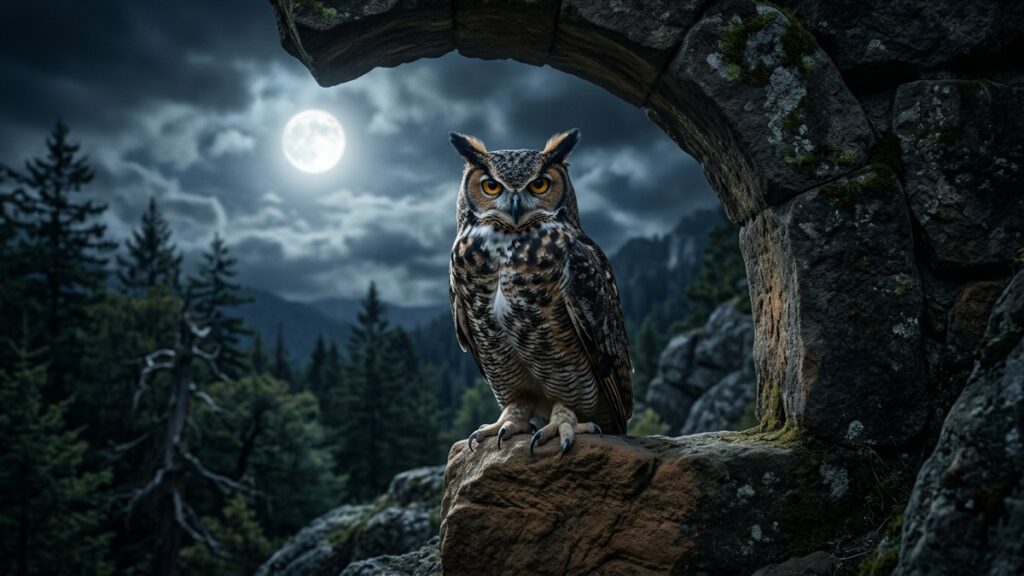
That historical moment captures the intense psychological weight of owl symbolism in the human psyche. Operating entirely at the edges of ordinary perception, the creature thrives in deep shadows where human vision falters and logic begins to break down. Observers long ago recognized a terrifying clarity in its steady, unmoving golden stare. The silent hunter embodies the rare capacity to see through deception and uncover buried truths.
Different cultures understood this penetrating vision in sharply conflicting ways. The indigenous Amis tribe revered these nocturnal watchers as faithful guardians of the dense forest. Villagers listened to their calls to predict the fate of unborn children sleeping in the womb. Yet traditional Chinese folklore feared the exact same midnight cries as omens of approaching death. An old proverb warns men against hearing the sudden, chilling laugh of the nocturnal hunter.
Such uncompromising sight can either protect your spirit or expose your deepest flaws. We constantly struggle with hidden motives, subtle lies, and the quiet voice of buried intuition. The night watcher asks us to look much closer at the reality we accept. It demands that we pierce the comfortable illusions we construct every single day.
Meeting this silent figure requires a genuine willingness to step into the dark. Trusting the subtle senses that operate far beyond everyday logic becomes the only way forward.
🏛️ Athena’s Gaze: The Birth of Western Wisdom
In ancient Greece, the owl was never considered a mere animal. It was the living, breathing manifestation of Athena. She was the formidable goddess of wisdom, reason, and martial strategy. Her sacred animal shared her unyielding, penetrating nature. The little owl, scientifically known as Athene noctua, populated the rocky hills of Athens. As documented in the archives of the American School of Classical Studies at Athens, the physical presence of the bird was viewed as a localized, protective deity.
The raw intensity of this belief surfaced on the battlefield. Greek soldiers standing on the bloody edge of combat often looked to the sky. An owl flying over the armed ranks was a profound, world-altering event. It was immediately interpreted as a prophetic bird omen. The men believed the Goddess of War was directly signaling her favor. The silent wings passing above them meant military victory was near. The bird brought mental order to the chaotic, bloody terror of warfare.
This was not the gentle wisdom of a quiet, bearded philosopher. It was the sharp, tactical clarity required to survive a brutal conflict. The image of the owl was stamped onto Athenian silver coins. These coins were known as tetradrachms, circulating widely throughout the ancient Mediterranean world. The bird became synonymous with the economic and intellectual power of the city. To hold an Athenian coin was to hold the watchful eye of Athena.
The owl eventually became the ultimate Western archetype of the learned individual. Modern idioms like “as wise as an owl” stem directly from this ancient root. Yet the original Greek conception was much more active and dangerous. Athena’s owl was a creature that saw through the thick fog of war. It pierced through enemy deception and blinding human panic. The bird represented absolute mental clarity in the darkest possible moments.
Its massive, forward-facing eyes missed nothing hiding in the shadows. This unique physiological trait gave the creature an air of supreme authority. The owl did not just look at the world. It judged what it saw with cold, unwavering precision. Over centuries, European cultures gradually softened this fierce mythological image. The ruthless companion of a war goddess evolved into a benign scholar.
Books and spectacles eventually replaced swords and shields in the popular imagination. Children’s stories began to feature the bird as a friendly, elderly teacher. Yet the original mythology carries a much sharper, more dangerous edge. The mythological owl favors cold truth over comforting fiction.
🌍 Guardians of the Forest: Taiwanese Aboriginal Myths
Moving away from Western logic, the archetype shifts dramatically in other regions. Various global cultures harbor a deep, instinctual fear of nocturnal creatures. Taiwanese aboriginal tribes, however, view the owl from a completely different perspective. They widely regard these silent birds as powerful symbols of good fortune. The owl acts as a fierce, active protector of the human community. It is intimately involved in the messy, physical cycle of life.
The Bunun people hold a particularly beautiful tradition regarding the bird. They revere the owl deeply as a “birth-giving bird.” It serves as a sacred guardian of vulnerable infants within the mountain villages. This contrasts sharply with the western archetype of abstract, detached intellect. For the Bunun, the owl is tied directly to physical generation and bodily survival. It watches over the fragile early days of new human life.
The Amis tribe maintains a similar, deeply rooted reverence for the creature. They view owls as the tireless, eternal guardians of the forest. The Amis believe these birds function as active spiritual messengers. They bring news of coming pregnancies to the sleeping village at night. The distinct sound of the owl’s hoot carries immense practical meaning.
Village elders listen closely to the rhythm, tone, and pitch of the call. Amis tradition uses this nocturnal sound to accurately divine the gender of the unborn baby. A certain resonant call indicates a boy, while a higher pitch predicts a girl. The owl bridges the wild, untamed forest and the domestic human home. It watches over the invisible boundary between the spirit world and physical birth.
The bird does not just passively observe the world from a safe distance. It actively participates in the survival and continuation of the entire tribe. The forest would feel empty and unprotected without the owl’s watchful presence. The indigenous relationship with the animal remains highly physical and immediate. The owl is respected as a neighbor, a messenger, and a guardian spirit.
🌙 The Ghostly Bird: Sight Beyond Deception
What does this creature represent at its deepest, most fundamental symbolic level? The owl symbolizes the rare human ability to perceive hidden truths. It operates masterfully in the dark spaces where human vision completely fails. The bird embodies deep intuition and the capacity to see through deception. It is one thread in the broader history of animal symbolism across human cultures.
Different owl species carry rich, beautifully layered interpretations in modern and ancient lore. Birding communities sometimes refer to the barn owl as the “Ghostly Bird of Prey.” Its pale, heart-shaped face links it to themes of love and emotional connection. Yet its entirely silent flight gives it a spectral, unearthly quality. A barn owl hunting at dusk looks exactly like a floating phantom.
It represents the quiet, unseen forces that constantly shape our daily lives. The snowy owl adds another profound dimension to the overarching archetype. Its striking white coloration suggests purity, spiritual illumination, and cleansing light. Snowy owls often represent periods of profound personal change and deep inner wisdom. They survive in the harshest, most unforgiving winter environments on earth.
Their extreme physical resilience grounds their spiritual meaning in sheer endurance. Biological reality closely mirrors this ancient symbolic wisdom in fascinating ways. Young owls demonstrate a high capacity for behavioral intelligence. They learn complex new routines and environmental associations quickly. More importantly, they readily abandon old habits if those actions lead to mistakes.
The biological trait translates directly into psychological meaning. The owl represents the mental flexibility required to abandon deep-seated self-deception. It asks the observer to drop false beliefs when they no longer serve reality. The bird demands a clear, honest, and unflinching assessment of the world. Many traditions understand this creature as a master of uncovering what is hidden. It strips away the comforting lies we tell ourselves in the dark.
🪶 The Anatomy of the Owl: Silence and Sight
The symbolism of the owl is deeply rooted in its unique physical anatomy.
Ancient people observed the bird closely. They translated its biology into myth. Physical reality became psychological truth.
The most striking feature is its completely silent flight. Unlike hawks or eagles, an owl makes almost no sound when it hunts. Special feathers dampen the noise of rushing air over its wings.
This silent approach gave the bird an almost supernatural reputation across many cultures. A creature that moves without sound seems to belong to the spirit world. It appears suddenly out of the darkness, striking without any prior warning. This physical reality feeds the myth of the owl as a ghostly messenger. It represents the sudden, unexpected arrival of truth or fate.
The second defining feature is the bird’s exceptional neck flexibility. An owl can rotate its head up to two hundred and seventy degrees. To an ancient observer, this looked entirely magical and slightly disturbing. The bird seemed capable of looking backward into the past. It could survey its entire surroundings without ever moving its body.
This biological trait cemented its reputation as a creature of total awareness. The owl became the ultimate symbol of vigilance and protective observation. It sees what is behind it just as clearly as what is ahead. The archetype exacts a similar psychological demand. The human mind is challenged to examine reality from every possible angle. The physical bird perfectly mirrors the psychological demand for complete, unflinching honesty.
🌑 The Unfilial Bird: China’s Omen of Death
The mythological record is not entirely positive, protective, or illuminating. In traditional Chinese culture, the owl carries a massive, unresolved shadow. It is heavily associated with bad luck, sudden misfortune, and physical death. Its strictly nocturnal nature made it a creature of deep cultural suspicion. The dark is traditionally where dangerous spirits and malicious thieves operate.
Ancient Chinese texts record a particularly dark and disturbing mythological belief. Certain folklore claims that young owls actually eat their own mothers. This gruesome myth permanently branded the creature as the “unfilial bird.” In a society built entirely upon elder respect, this is the ultimate transgression. The owl became a powerful symbol of unnatural, horrifying social inversion.
It represented the complete breakdown of family order and universal moral law. The terror associated with the bird extended to its strange vocalizations. A chilling folk proverb perfectly captures this widespread cultural dread. The ominous saying warns: “Not afraid of the owl’s hoot, but afraid of the owl’s laugh.”
The strange, shrieking calls of certain owl species sound disturbingly human. Hearing this manic sound in the dead of night terrified rural villagers. They believed the laughing owl was actively mocking human fragility and mortality. It was considered a direct harbinger of imminent tragedy or severe sickness. The sound echoed through dark valleys, promising sorrow to anyone who heard it.
Some historical accounts suggest people placed protective charms on their roofs. These amulets were designed explicitly to ward off the laughing owl. The fear was not just psychological; it dictated physical actions and architecture. A bird that defied the natural order of family loyalty was a profound threat. It carried the chilling energy of the underworld directly into the human world.
🦉 The Unblinking Stare: What Remains Unresolved
The owl leaves behind a highly complex and deeply contradictory cultural legacy. It exists simultaneously as a sacred guardian and a terrifying omen. The figure refuses to be easily categorized by rigid human moral standards. It brings the vital gift of prophecy but also the chilling threat of death.
This ancient archetype keeps asking a difficult, unresolved question. Are we truly prepared to see what the darkness actually hides? The owl demands absolute clarity from anyone who crosses its silent path. It forces the observer to look past comforting, socially acceptable illusions. The core tension lies entirely in the bird’s unblinking, golden stare.
That famous gaze is entirely neutral, objective, and deeply unforgiving. It does not offer warmth, pity, or easy reassurance to the viewer. The goddess of wisdom’s sacred animal expects rigorous, brutal honesty at all times. It waits patiently in the shadows, watching every single movement we make. We cannot hide our true intentions from a creature that sees in the dark.
The myth never resolves our ancient, primal fear of the night. It simply places a silent, uncompromising watcher inside that terrifying darkness. The owl sits in perfect stillness, waiting for the hidden truth to emerge. It demands that we open our eyes to the reality of the night. The archetype leaves us standing alone in the dark, forced to see clearly.
The Watcher in the Dark
Meeting this silent hunter requires stripping away our comfortable, everyday illusions. The bird does not offer warm reassurance or gentle, maternal guidance. Instead, its unmoving stare dismantles the daily lies we tell ourselves. Avoidance takes immense psychological effort. We constantly build bright, artificial lights to keep the unknown at bay. Yet the deepest human truths hide exactly where we refuse to look.
Athena’s companion demands a terrifying clarity from anyone crossing its path. It waits patiently at the very edges of our fractured perception. You cannot bargain with a creature that naturally sees through the dark. The ancient indigenous forest guardians understood this silent vigil perfectly. The watcher outlasts our human panic. It simply observes until your own eyes finally adjust to the gloom. The encounter forces a quiet, unavoidable reckoning with the fears you keep buried.
There is a distinct, heavy tension in waiting for the truth to surface. You might feel a sudden, overwhelming instinct to look away from that gaze. The night demands a strange kind of surrender from us. A heavy shadow detaches from the high branches above. Pale feathers part the cold air without making a single sound. Two bright yellow eyes open wide against the black sky.
❓ Frequently Asked Questions
Is it rare to see an owl?
Encountering an owl in the wild is relatively uncommon due to their strictly nocturnal habits and exceptional camouflage. Their silent flight and preference for dense cover mean they often observe humans long before they are detected. Spotting one usually requires deliberate tracking at dusk or dawn rather than casual observation.
Why is the owl sometimes considered a dark or satanic symbol?
The association with dark forces stems primarily from medieval European superstitions and traditional folklore that feared the night. Because the bird operates in total darkness and possesses a haunting, human-like call, early religious authorities frequently linked it to witchcraft, secrecy, and the underworld.
What does it mean when a Native American sees an owl?
Interpretations vary drastically among different tribes, ranging from protective omens to warnings of imminent danger. While some groups view the bird as a sacred guardian spirit or a messenger from ancestors, others consider its sudden appearance a strict warning of sickness or approaching death.
For a broader understanding of this symbolic tradition, explore our complete guide to Why Animal Symbolism Awakens the Primal Mind.
Explore Related Topics

Dalton Treviso is a depth psychology researcher and writer exploring how archetypes, shadow work and ancient philosophy illuminate the hidden structures of the human psyche.
Drawing on Jungian psychology, Stoic thought and mythological symbolism, his work examines how the inner patterns we carry shape perception, suffering and transformation.
Through EINSOF7, Dalton writes about the symbolic architecture of the mind — helping readers understand how myths, archetypes and philosophical traditions can act as both mirror and map for psychological depth and self-understanding. More about me click here.