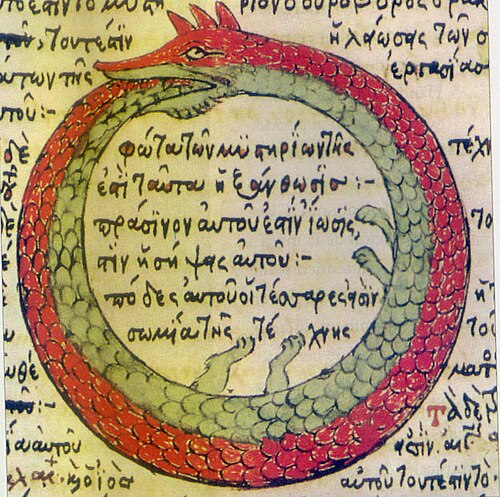

There’s something quietly unsettling about the image: a serpent curled into a perfect circle, mouth locked around its own tail. It shouldn’t make sense — an animal consuming itself is destruction, not harmony. And yet across five thousand years of human history, people from ancient Egypt to Renaissance Europe kept returning to this image and calling it sacred. The ouroboros meaning, it turns out, has less to do with self-destruction and everything to do with the one thing no culture has ever been able to escape: cycles.
The word ouroboros (also spelled uroboros) comes from the ancient Greek oura (tail) and boros (eating) — literally, “tail devourer.” But what began as a description became one of history’s most enduring symbols, appearing independently across cultures that could never have communicated with each other. That kind of convergence is rarely accidental.
The Ancient Origins of the Ouroboros 🐍
The oldest known representation of the ouroboros was found inside the tomb of Tutankhamun, buried with the young pharaoh around 1350 BCE. Discovered in the chamber known as KV62, the image appears in an ancient funerary text called the Enigmatic Book of the Netherworld — a guide to Ra’s nightly journey through the underworld, where the sun god merges with Osiris before being reborn at dawn.
In the tomb painting, two serpents appear: one encircling the head and chest of a divine figure, the other surrounding its feet. Together, they frame the body of the unified Ra-Osiris — the god of death becoming the god of sunrise. The ouroboros meaning here is cosmological: night swallows day so that day can emerge again. The cycle never breaks because the symbol that represents it never ends.
Scholars trace earlier precursors to around 1600 BCE in Egyptian iconography, suggesting the symbol predates even Tutankhamun’s tomb. From Egypt it passed to the Phoenicians, who carried it through Mediterranean trade routes, and from there to ancient Greece, where philosophers and mystics gave it the name we still use today. By the time Greek magical practitioners adopted it in their papyri, the ouroboros had already accumulated centuries of accumulated meaning.
It’s striking that the Egyptians chose a serpent rather than, say, a river or a wheel to represent eternal return. The snake sheds its skin — visibly renewing itself — and moves in fluid curves that suggest no clear beginning or end. In a culture that built monuments designed to last eternity, the choice of the most self-renewing animal to symbolize cosmic permanence makes a certain profound sense.
What Does the Ouroboros Symbolize? 🔄
At its core, the ouroboros meaning centers on a single idea: that opposites are not enemies but partners in a single process. Endings contain beginnings. Destruction enables creation. The serpent eating its tail is dying and sustaining itself simultaneously.
This idea shows up across several distinct interpretive layers:
- Eternal cyclic renewal: The most universal reading — seasons, generations, civilizations rise and fall in patterns that mirror the serpent’s loop. Nothing is truly finished; everything returns.
- The unity of opposites: The mouth (the receiving, feminine principle) and the tail (the giving, masculine principle) are joined. Gnostic thinkers especially emphasized this: the ouroboros transcends duality.
- The transmigration of souls: The serpent’s annual skin-shedding made it a natural emblem for metempsychosis — the idea that the soul passes through multiple lives, each death releasing it into a new form.
- Cosmic containment: In some cosmologies, the ouroboros doesn’t just symbolize cycles — it is the boundary of the universe. The world exists inside the serpent’s body. Beyond its coils, there is nothing.
What’s notable is how little the core meaning shifts between cultures. Whether you encounter the ouroboros in a pharaoh’s tomb or a 17th-century alchemist’s notebook, the message is remarkably consistent: time is not a line. It is a circle. Or — if you look closely at the figure-eight variant — something even stranger than a circle.
The Ouroboros Across Cultures 🌍
One of the most compelling arguments for the ouroboros as a genuinely universal symbol is how many cultures developed equivalent images without contact with Egypt or Greece.
In Norse mythology, the World Serpent Jörmungandr — offspring of Loki — was said to encircle the entirety of Midgard (the human world), biting its own tail to hold the cosmos together. Should Jörmungandr ever release its grip, the world would end. This is not a symbol of threat but of restraint: the serpent’s self-consumption is the act that holds reality in place.
Hindu tradition offers Ananta Shesha (also called Adishesha or Shesha Naga) — the infinite cosmic serpent on whom Vishnu rests between cycles of creation. Ananta means “endless” in Sanskrit. The serpent’s coils represent the infinite nature of time itself, and its self-devouring form marks the moment between one cosmic age ending and the next beginning.
In Mesoamerican traditions, the feathered serpent Quetzalcoatl carries overlapping symbolism — a divine being associated with wind, cycles of Venus, and the recurring destruction and creation of worlds. The Aztec calendar stone itself is framed by two serpents, heads meeting at the bottom, echoing the ouroboros form.
Even in West African and Chinese traditions, serpentine figures appear looping into themselves around cosmological diagrams. The convergence is too consistent across too many isolated cultures to be coincidence. Something in the coiling serpent matches something in how human minds naturally model cyclical time.
The Ouroboros in Alchemy and Hermeticism ⚗️
When the ouroboros entered the Western esoteric tradition through Gnosticism and eventually alchemy, it gained a new layer of meaning: transformation as a personal and spiritual project.
For alchemists, the ouroboros symbol represented the foundational process of their work — solve et coagula, dissolve and coagulate. Matter had to be broken down before it could be refined into something higher. The serpent eating itself is the prima materia consuming itself to produce the philosopher’s stone. Rebirth requires a kind of self-annihilation.
The alchemical ouroboros also appears frequently alongside the phrase “hen to pan” — Greek for “the one, the all.” This Hermetic idea, central to the tradition attributed to Hermes Trismegistus, held that all matter is ultimately one substance in different states of refinement. The ouroboros visualizes this unity: there is no separate predator and prey; the serpent is both.
Gnostic traditions developed the ouroboros as a symbol of Abraxas — the supreme god that contains all opposites, light and dark, good and evil. In Gnostic cosmology, the material world is a prison of cycles from which the enlightened soul seeks escape. The ouroboros both describes that trap and hints at transcendence: only by understanding the cycle can you step outside it.
By the 17th century, Masonic imagery had incorporated the ouroboros extensively, often depicting it alongside compasses and the all-seeing eye. It appeared on lodge seals, ritual regalia, and architectural symbolism — always as a marker of wholeness, completion, and the eternal nature of wisdom.
Carl Jung and the Ouroboros 🧠
Carl Jung’s engagement with the ouroboros gives us perhaps the most psychologically rich interpretation of the symbol. Jung encountered it through his extensive study of alchemical texts, and he recognized in it something that matched his core theory of the psyche.
For Jung, the ouroboros represented what he called the uroboric state — the primordial condition of the unconscious before individual consciousness differentiates itself. Infants exist in a kind of uroboric unity: self and world, inner and outer are not yet separated. The serpent’s self-sufficiency mirrors this early psychological wholeness that precedes the development of a distinct ego.
But Jung went further. In his Psychology and Alchemy and later in Mysterium Coniunctionis, he interpreted the ouroboros as a symbol of the Self — not the ego (the conscious “I”), but the total psyche, including everything unconscious. The Self contains all the opposites that the ego struggles to reconcile. The serpent devouring its tail is the psyche metabolizing its own shadow material — integrating what was rejected, completing the circle of individuation.
This psychological reading connects the ouroboros to the process Jung called individuation: the lifelong journey toward becoming a more whole, integrated person. The symbol, on this reading, is not about eternal recurrence as a trap but about the spiral nature of psychological growth — we return to the same themes, but each time from a higher vantage point. The circle has become a helix.
One finds echoes of this in how people commonly describe certain life patterns: “I keep ending up in the same situation.” Jung might say: the ouroboros is still active in you. The cycle continues until it’s understood from the inside.
The Ouroboros Symbol in Modern Life 💡
The ouroboros has made a quiet but persistent journey into contemporary culture, often stripped of its esoteric context but retaining its visual power.
The most significant modern echo is the infinity symbol (∞). Mathematical historians generally agree that the figure-eight variant of the ouroboros — the serpent looped before biting its tail — directly influenced John Wallis when he introduced the ∞ symbol in 1655. The connection between “a serpent without end” and “a number without bound” was not metaphorical. It was definitional.
In tattoo culture, the ouroboros ranks among the most requested ancient symbols. People choose it for a range of reasons: a reminder of resilience, a marker of personal transformation, a symbol of grief processed and metabolized, or simply because the image of infinite renewal resonates with something they’ve lived through. The symbol’s ability to hold multiple meanings simultaneously — without collapsing into sentimentality — seems to be part of its enduring appeal.
It appears in literature and film as a structural principle as much as an image. Stories that end where they begin, characters who repeat their ancestors’ mistakes until they finally don’t, myths of civilizations that rise and fall in recognizable patterns — all of these carry the ouroboros logic, even when the serpent never appears explicitly.
Within sacred geometry, the ouroboros is sometimes grouped with mandalas and the infinity symbol as forms that encode the same mathematical insight: that closed curves can contain infinite complexity. The serpent that eats itself creates an interior space — a bounded infinity — that recurs in everything from fractal geometry to the mathematics of black holes.
There is something almost consoling about a symbol that has survived five millennia. Cultures rise, languages die, empires collapse — and yet here is this image of a snake biting its tail, still recognizable, still meaning roughly what it has always meant. The cycle continues. The serpent holds.
Conclusion
The ouroboros began as a cosmological image — two serpents framing a god in a pharaoh’s tomb, holding the structure of night and day in place. Across thousands of years and dozens of cultures, it kept resurfacing wherever people tried to think clearly about time, transformation, and what endures.
What makes the ouroboros meaning so durable is its precision. It doesn’t describe cycles vaguely — it depicts them structurally. The serpent is not a metaphor for cyclical time; it is cyclical time rendered as geometry. You can see, in a single image, that the end feeds the beginning, that destruction and creation share a body, that the boundary of a thing and the thing itself are inseparable.
Jung’s contribution was to point out that this ancient cosmological insight is also a psychological truth. The patterns we repeat, the themes we keep circling, the aspects of ourselves we haven’t yet integrated — these are our personal ouroboros. The symbol doesn’t just describe the cosmos. It describes the structure of growth itself: spiraling, returning, but never quite arriving at the same place twice.
If you encounter the ouroboros — in an old manuscript, a piece of jewelry, or the feeling of starting over once again — it may be worth pausing on what the ancient Egyptians understood about this image. A serpent eating its tail is not an image of futility. It is an image of a system that sustains itself. The cycle is not the trap. Mistaking it for a straight line is.
For more on ancient symbols and their deeper meanings, explore our guides on ancient symbols and the role of sacred geometry in world traditions.
Frequently Asked Questions About the Ouroboros
What does the ouroboros mean?
The ouroboros meaning centers on eternal cycles, self-renewal, and the unity of opposites. Literally “tail devourer” in Greek, the image of a serpent eating its own tail represents the idea that endings and beginnings are part of the same continuous process — that destruction and creation share one body. Across cultures, it signifies the cyclical nature of time, the cosmos, and transformation.
Is the ouroboros a good or bad symbol?
The ouroboros is neither inherently good nor bad — it is a symbol of wholeness and cosmic order. In alchemical tradition, it represented necessary transformation. In Jungian psychology, it symbolizes the totality of the psyche. In Norse mythology, its grip holds the world together. Most traditions regard it as a sign of renewal and the integration of opposites rather than as a threatening symbol.
What is the connection between the ouroboros and the infinity symbol?
The mathematical infinity symbol (∞) is widely believed to derive from a variant of the ouroboros in which the serpent is looped once before biting its tail, creating a figure-eight shape. Mathematician John Wallis introduced the ∞ symbol in 1655, and historians of mathematics generally trace its visual form to this looped ouroboros tradition. The connection between “a serpent without end” and “a number without bound” was conceptually, not merely visually, linked.
What does Jung say about the ouroboros?
Carl Jung saw the ouroboros as a symbol of the uroboric state — the primordial undifferentiated condition of the psyche before ego consciousness develops. He also interpreted it as a symbol of the Self (the total psyche, including unconscious dimensions) and as a visual representation of individuation: the lifelong process of integrating the shadow and becoming psychologically whole. In his alchemical studies, Jung connected the ouroboros to the process of the psyche metabolizing its own rejected material.
Where is the oldest known ouroboros found?
The oldest confirmed ouroboros representation was discovered in the tomb of Tutankhamun (KV62) in the Valley of the Kings, Egypt, dating to approximately 1350 BCE. It appears in the Enigmatic Book of the Netherworld, framing a divine figure representing the unified Ra-Osiris. Earlier precursors in Egyptian iconography have been dated to around 1600 BCE, suggesting the symbol was already well-established before Tutankhamun’s reign.

Dalton Treviso is an independent researcher and writer exploring archetypes, Jungian psychology, and mythological symbolism. His work focuses on how ancient philosophical traditions and symbolic systems illuminate the hidden structures of the human psyche.
Drawing on Jungian psychology, Stoic thought, and comparative mythology, Dalton examines how the inner patterns we carry shape perception, conflict, and transformation.
Through EINSOF7, he writes about the symbolic architecture of the mind — exploring how myths, archetypes, and philosophical traditions act as both mirror and map for psychological depth and self-understanding.
Areas of study: Jungian archetypes, animal symbolism, dream symbolism, mythological figures, and ancient symbolic traditions.