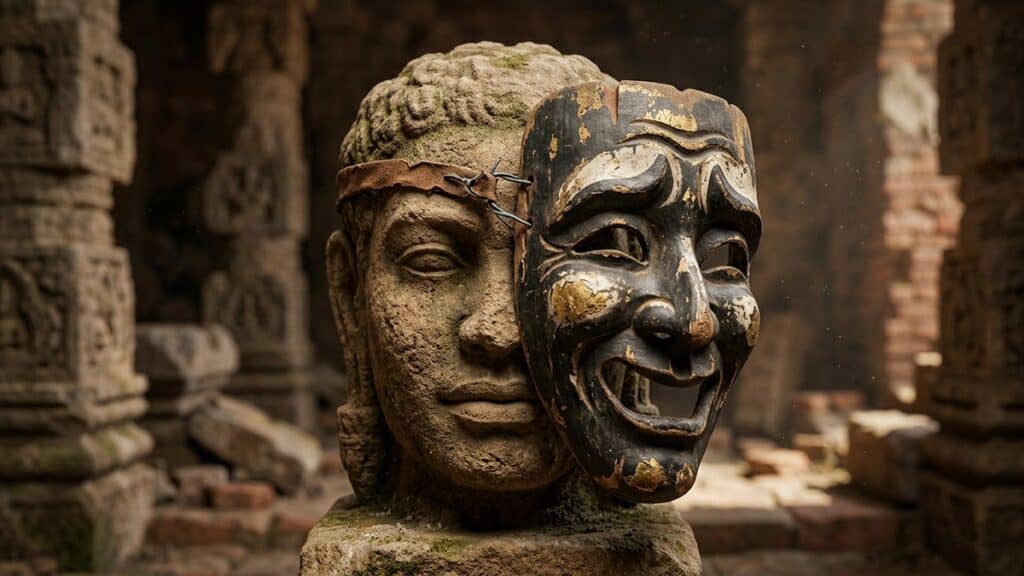
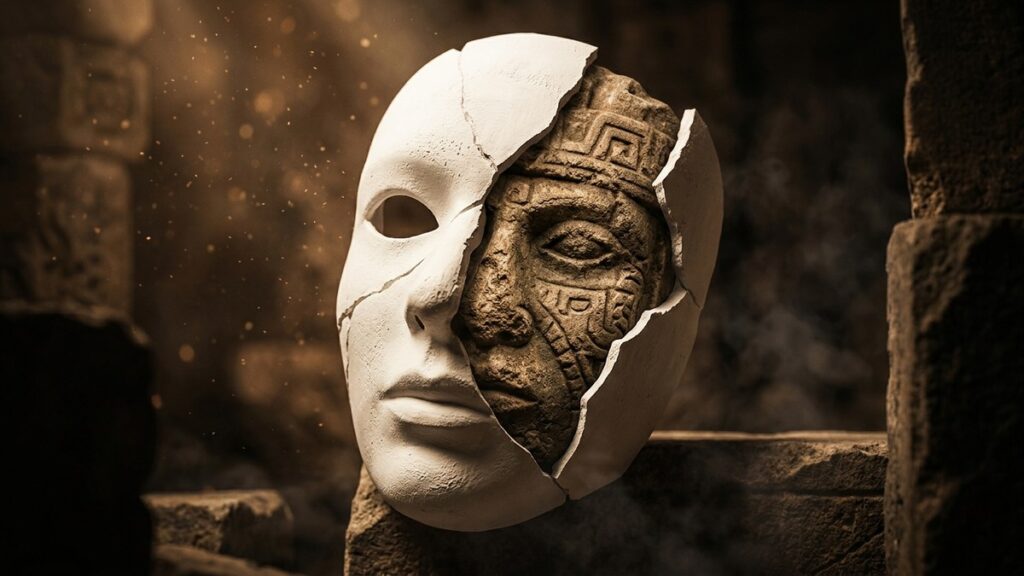
In our modern, disenchanted age, we are besieged by digital personality quizzes that promise to reduce the infinite complexity of the human soul to a set of neat, colorful boxes. These superficial labels offer a fleeting hit of recognition, but they fail to touch the profound, often terrifying depths of who we actually are. To ask how to know your archetype? is not an exercise in curiosity; it is a question of spiritual and psychological urgency.
Jung and Campbell reveal that these patterns do not begin with our personal history. They emerge from the “collective unconscious”—a shared, primordial reservoir of cognitive structures evolved over the vast span of human history. As Joseph Campbell famously wrote:
“The symbols of mythology are not manufactured; they cannot be ordered, invented, or permanently suppressed. They are spontaneous productions of the psyche.”
— Joseph Campbell
The Hero’s Journey: Your Archetypal Blueprint
Joseph Campbell, who spent his lifetime mapping the world’s mythologies, discovered something that should stop us cold: beneath the surface of thousands of different myths from every culture on earth lies a single, recurring pattern. He called it the monomyth, or the hero’s journey. And it is not a story about someone else. It is the precise map of the journey you are already on—whether you know it or not.
The journey always begins with a Call to Adventure—often personified in myth as an animal the hero encounters, symbolic of one’s instincts. These gut feelings are insightful but too often ignored. In Campbell’s words, “Refusal of the summons converts the adventure into its negative. Walled in boredom, hard work, or culture, the subject loses the power of significant affirmative action and becomes a victim to be saved.” Refusing to ask which archetype moves you is itself a refusal of the call.
At the boundary of the unexplored psyche, the hero meets the Threshold Guardian—the menacing figure representing one’s own Shadow: the rejected, uncomfortable portions of personality. To confront and accept this shadow is to gain the inner strength needed for the rest of the journey. Descend further, and the previous self begins to disintegrate; a new, more complete self begins to form. In myths, this is the stage of death and rebirth—the hero enters the belly of the whale and emerges transformed.
Crucially, the journey does not end with self-discovery. The hero must return and bring the discovered potential back into the world. “The whole point of this journey is the reintroduction of this potential into the world,” Campbell insisted. “Bringing the boon back can be even more difficult than going down into your own depths in the first place.” To know your archetype is not a destination—it is a responsibility.
It’s Not a Label, It’s a Relationship
Discovering your archetype is not about finding a new title to wear; it is about repairing a torn ligament in the soul. Edward Edinger reveals the terrifying reality that most of us live in a state of “alienation,” where the Ego has been severed from the Self—the objective, ordering center of the total psyche.
The etymology of “religion” lies in re-ligare—to bind back, like a ligament adhering to bone. This is the “Ego-Self Axis.” When this axis is re-established, usually after an experience of intense suffering, the ego realizes it is not the master of its own house, but a subordinate to a transpersonal center.
“For contemporary men and women… the encounter with the self is equivalent to the discovery of God.”
— Edward Edinger, Ego and Archetype
Sacrificing Potential for Reality
A primary obstacle to knowing your true nature is the trap of the puer aeternus—the “eternal youth” who is all promises and no fulfillment. To find your archetype, you must perform a painful sacrifice: give up being “everything in potentia” to finally become something in fact. As Edinger warns: “voluntarily accept being a real fragment instead of an unreal whole.” You cannot be all archetypes; you must discover which specific fragment of the divine you are meant to embody.
Take the Quiz
Which Jungian Archetype Are You?
5 symbolic questions. Journey through wolves, mirrors, and cosmic voids to reveal your dominant archetype — Shadow, Hero, Trickster, Great Mother, or Wise Old Man.
Look to Your Follower: The Norse Secret of the Fylgja
If you wish to see your “real fragment” clearly, look to the ancient Norse concept of the fylgja (Old Norse for “follower,” pronounced FILG-ya). This was not a metaphor for the Vikings; it was a relationship of spiritual kinship. Every person was accompanied by an animal spirit that mirrored their essential character. The urgency is literal: the well-being of the fylgja is intimately tied to that of its owner. If the fylgja dies, the owner dies.
- The Bear fylgja: Belonging to those of noble birth or immense, grounded strength—the famous “berserkers” (“bear-shirts”) who entered battle in a state of ecstatic fury.
- The Wolf fylgja: Reflecting a savage, predatory character—the “úlfheðnar” (“wolf-hides”), elite warriors who wore wolf pelts as an outward reminder that they had gone beyond the confines of their humanity. See also: animal symbolism across cultures.
- The Pig fylgja: Symbolic of a gluttonous nature.
The Norse berserker initiations are particularly revealing. Candidates were sent alone into the wilderness to live in imitation of their totem beast—hunting, surviving, and moving as the animal would. Gradually, imitation gave way to identification. The warrior achieved a state of spiritual unification with the bear or wolf. As one scholar described it: “Rapto vivere, to live in the manner of wolves, is the beginning of this initiation.” This was not metaphor; it was a psychological technology for discovering which beast lived inside them.
This knowledge is not unique to the Norse. Across the globe, cultures developed their own version of this truth. In Aboriginal Australia, individuals identified with a totemic ancestor from a mythical past known as “The Dreaming,” binding their identity to a creature that expressed their deepest nature. For Joseph Campbell’s “Way of the Animal Powers,” the hunted buffalo of the Native American plains was recognized as “springing from an eternal archetypal source and coming to this world as a willing victim.” In ancient Egypt, the gods themselves wore animal heads: Anubis the jackal guided souls through the underworld; Horus the falcon embodied divine kingship. These hybrid figures—part human, part beast—were not primitive confusion. They were sophisticated maps of the psyche, showing how the untamed energies of nature fuse with human consciousness.
In modern life, your fylgja speaks through recurring dreams, an undeniable affinity for a specific creature, or the animals that have appeared as guides at turning points in your life. This is the psyche revealing the archetypal animal spirit that overlaps with your human self.
Beware of Inflation: When the Archetype Takes Over
There is a grave danger in this search: “Ego Inflation.” This happens when the ego identifies so closely with an archetype that it begins “living out an attribute of deity.”
- The Yahweh Complex: Blinding anger, attempting to force and coerce the environment.
- Negative Inflation: Excessive guilt—“no one is as guilty as I am”—is secret pride. A claim to be the greatest sinner is as inflated as claiming to be a god.
You must learn to distinguish between having an archetype and being possessed by one. To be possessed is to lose your humanity; to have a relationship is to find your soul.
The Accidents Are the Map
How do archetypal powers communicate when we aren’t looking? Jung proposed “sophisticated primitivity.” To the primitive mind, there is no “chance”; everything is saturated with psychic meaning.
“To this day God is the name by which I designate all things which cross my willful path violently and recklessly, all things which upset my subjective views, plans and intentions and change the course of my life for better or worse.”
— Carl Gustav Jung
When your plans are wrecked by a “reckless” coincidence, you may be standing in the presence of an archetypal force trying to get your attention.
Four Practical Steps to Discover Your Archetype
The sources converge on four concrete practices that initiate genuine archetypal discovery. These are not intellectual exercises; they are acts of psychological courage.
1. Work Your Dreams. Jung described dreams as “a dialogue between ego and the Self—the Self aspires to tell the ego what it does not know, but should.” Archetypes—the Shadow, the Anima, the Wise Old Man—manifest in dreams as autonomous figures. Begin keeping a dream journal. Do not rush to interpret. Instead, “stick to the image,” as Jung advised: explore your personal associations with each figure as vividly as possible. The old man. The wolf. The burning house. What do you associate with these? The answer is your material.
2. Accept Your Shadow. The first guardian you will meet at the threshold of your psyche is the part of yourself you have most aggressively rejected. Your Shadow carries everything you were told not to be. Edinger observed that the healing process for most people “involves an acceptance of what is commonly called selfish, power-seeking, or autoerotic.” The urges you deny in yourself are the first clues to which archetypal energy you are suppressing. The hero who accepts the Shadow does not become monstrous—they become whole.
3. Treat Accidents as Messages. Adopt what Edinger called “sophisticated primitivity.” Recognize that “no psychic happening is fortuitous.” When your carefully laid plans are derailed by an unexpected event—a chance encounter, a sudden illness, a door that closes without warning—do not retreat into the comfortable category of “bad luck.” Ask instead: what is this redirecting me toward? The force that wrecks your plans and the archetype that calls you forward are often the same force.
4. Detach Your Worth From Your Talents. One of Edinger’s most counterintuitive insights: “It is a mistake to identify our individuality with any particular talent, function or aspect of ourselves.” As long as you define yourself by your intelligence, your career, or your skills, you remain perpetually threatened by anyone more skilled. The archetype you carry exists “beyond all particular manifestation.” Your worth is not your performance. It is the specific fragment of the divine that you, and no one else, are meant to embody.
The Journey Toward the Philosopher’s Stone
The process of individuation is the transition from “unconscious identification” to a “conscious relation” with the powers that move us. To know your archetype is to realize that you already have all you need, and that every psychic event is meaningful. It is to stop being a victim of accidents and start participating in the unfolding of your destiny.
If the “accidents” in your life were actually a conversation with your deeper Self—what is your archetype trying to tell you today?

Dalton Treviso is an independent researcher and writer exploring archetypes, Jungian psychology, and mythological symbolism. His work focuses on how ancient philosophical traditions and symbolic systems illuminate the hidden structures of the human psyche.
Drawing on Jungian psychology, Stoic thought, and comparative mythology, Dalton examines how the inner patterns we carry shape perception, conflict, and transformation.
Through EINSOF7, he writes about the symbolic architecture of the mind — exploring how myths, archetypes, and philosophical traditions act as both mirror and map for psychological depth and self-understanding.
Areas of study: Jungian archetypes, animal symbolism, dream symbolism, mythological figures, and ancient symbolic traditions.