
In 1596, Johannes Kepler looked at the stars and saw shapes. He didn’t think the gaps between planets were random accidents. Instead, he modeled the solar system using nested geometric solids to show that the distance between orbits was a deliberate choice. Here’s the thing: this perspective lies at the heart of sacred geometry. It suggests that structure comes before matter. Before a tree or a star exists, its pattern is already there. The universe isn’t just full of shapes. It’s made of them.
Nature repeats these designs everywhere. You’ll see a nautilus shell growing in a perfect spiral. Even the way cells divide in a human embryo looks exactly like the Egg of Life, which is the same pattern you see in the tile work of ancient Iranian mosques. These designers weren’t just trying to make things look pretty. They wanted to copy the world’s basic logic. It’s about mimicry. Humans build things to mirror how the universe builds itself.
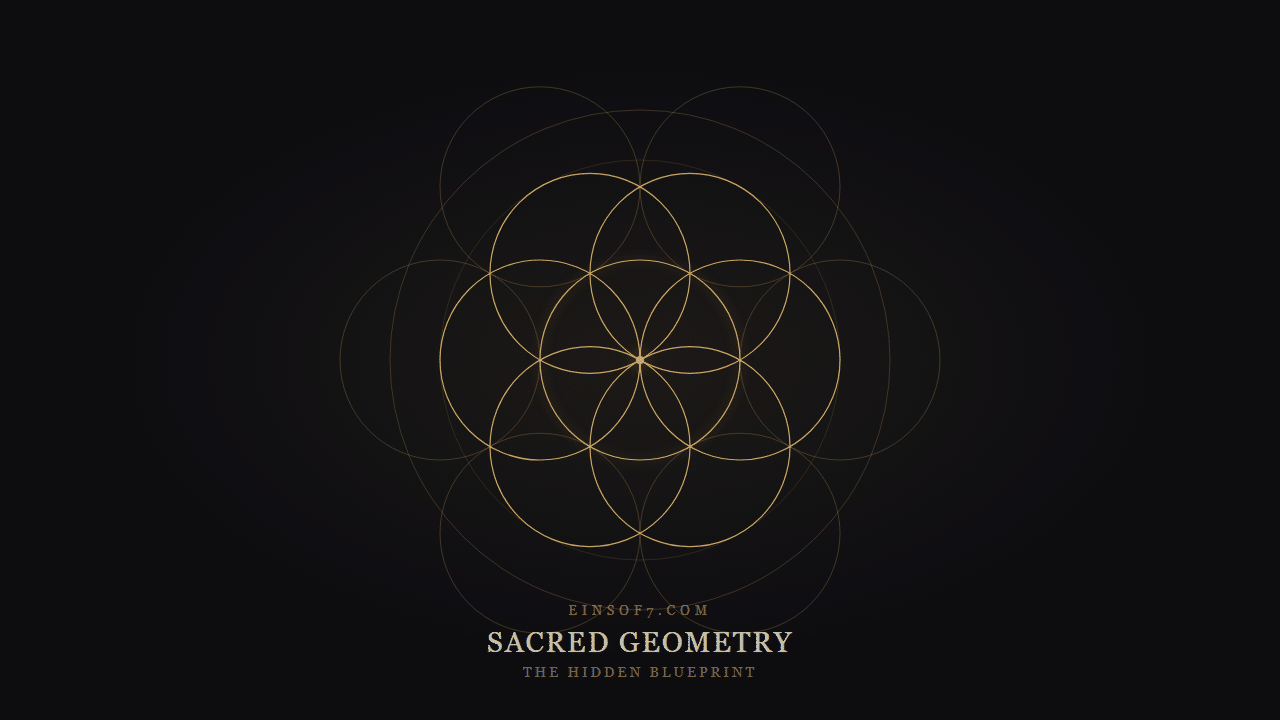
Plato supposedly said that God geometrizes all the time. It’s a bold claim. But if you look closely, the world isn’t a chaotic mess. It’s a system of numbers and forms. Symbols like the Flower of Life work as a silent language. It’s basically a map of everything. Seven circles overlap to tell a story of how things began. It shows you how one single thing splits apart to create the massive variety we see today.
Learning about these shapes changes how you see things. It isn’t just about looking at cool art. When you draw these patterns with a compass, your mind starts to sync up with universal laws that govern the stars. You begin to see the hidden skeleton of reality. That’s the point. Suddenly, the idea that everything is separate starts to fade away. Life feels less messy when you recognize the order underneath it all. That pattern exists in the stars, but it’s also right there inside you.
📐 The Language of the Divine Geometer
Learning sacred geometry is like picking up the vocabulary of the universe. It isn’t a mess of random events. You’re looking at a structured unfolding of patterns. At the heart of this idea sits the concept of the “Divine Geometer.” Plutarch famously recorded this in the first century when he attributed the phrase “God geometrizes continually” to Plato as a summary of his philosophy.
The physical world looks different through this lens. A flower isn’t some biological accident. It is a physical manifestation of the golden ratio, proving that beauty follows a set of rules. You’ll see the orbit of a planet as more than just a path shaped by gravity. That line is drawn across a cosmic canvas. Think of geometry as the bridge between spirit and matter. Robert Lawlor explains in his book Sacred Geometry: Philosophy and Practice that these shapes show how the spirit moves within the material world.
The greatest minds of antiquity lived by these rules. They didn’t separate math from meaning. When architects in the Middle Ages designed a cathedral or Greeks built the Parthenon, they wanted to mirror the perfection of the heavens on earth. Ancient builders created a temenos. This was a sacred enclosure cut off from the common world and defined by specific proportions.
Biology shows these same patterns. Look at the “Egg of Life” symbol. This specific arrangement of circles looks exactly like a human embryo during its third cellular division. The visual echo suggests that the same laws governing the birth of a star govern your own life, whether you see it in the spiral of a shell or a honeycomb. Nature follows a code.
🌸 The Flower of Life: A Universal Blueprint
You’ll find one specific pattern popping up all over the ancient world. It shows up in Egypt’s Osirion temple and then appears again in Beijing’s Forbidden City. These cultures never met. The design itself consists of nineteen complete circles and thirty-six partial arcs held inside a larger ring. It’s quiet. But it’s everywhere.
Most people call this lattice the grandmother of sacred shapes. It’s a map of how everything connects. If you look at it long enough, you’ll see other forms start to jump out from the grid. Some think the way light breaks apart or how cells grow fits perfectly into this hexagonal layout. It’s a bold claim. Yet, the math holds up.
Priests used to guard this symbol. In some places, builders burned it right into the stone so no one could ever rub it away because they wanted to show that the laws of nature don’t change. You have to wonder whether we’re actually as separate as we feel. This pattern suggests we all share the same basic plan.
Read the full guide: The Flower of Life in Global Temples →
🛡️ Metatron’s Cube: The Scribe’s Protective Seal
Think of the Flower of Life as the soft side of existence. Metatron’s Cube is its counterpart. It brings a sharp energy defined by straight lines and clear boundaries. The name comes from Archangel Metatron. Mystics call him the celestial scribe. You build the pattern by taking thirteen circles and connecting the center of every single one to every other circle with a straight line. It looks busy. It is also quite beautiful.
This web contains the two-dimensional shadow of every Platonic solid. That’s a big deal because these five shapes form the building blocks of our physical world, from crystals to the very DNA in your body. People often use this symbol to ward off bad energy. It links back to the idea of Metatron recording human deeds. You can look at it as a map showing how pure energy takes shape.
This shape is all about balance. When your life feels messy, you can use this geometry to clear your head. It works like a filter. The lines are so detailed that they force your brain to focus on order rather than chaos. This process pulls you out of a bad mood and into a steady, analytical state of mind. It isn’t just art. You can think of it as a shield.
Read the full guide: Archangel Metatron and His Protective Geometry →
🕉️ The Sri Yantra: Sound Become Form
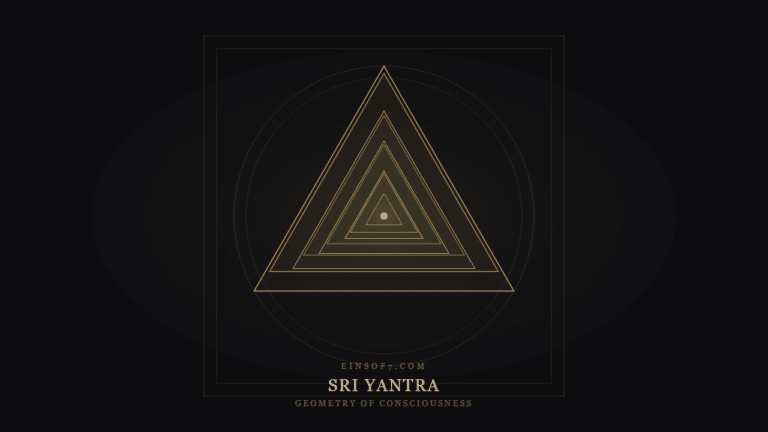
Vedic traditions treat the Sri Yantra as the peak of sacred geometry. It consists of nine interlocking triangles. Four point up to represent Shiva, while five point down for Shakti. When they meet, they form forty-three smaller triangles that all start from a single center point called the bindu. It looks complex because it is.
Think of it as a map for spiritual growth. While some patterns feel still, this one captures the constant movement of the cosmos. It represents the visual form of the “OM” vibration. You’re looking at a visual diagram of the specific noise the universe makes as it pushes outward into the void.
Drawing this symbol is a nightmare for most mathematicians. You need perfect precision to get every line to cross without leaving tiny gaps. This difficulty reflects how hard it is to find real inner balance. It takes focus. Nobody knows how ancient artists managed it without modern tools. Most people use it for meditation. You start at the outer edges and move inward toward the center. This process helps you leave the physical world behind and find a state of pure awareness.
Read the full guide: Bridging Vedic Geometry and Western Math →
✒️ Ink as Talisman: The Psychology of Geometric Tattoos
People don’t just leave these shapes on paper. They wear them. This isn’t just about looking cool. It’s a way to connect your physical self with the steady patterns that hold the universe together. Think of the ink as a permanent anchor that keeps you steady even when your daily life feels messy, loud, or completely lopsided.
Placement matters. You’ll rarely see these designs tattooed at random. Someone might choose their heart or spine to focus on specific parts of their body. The pain of the needle serves a purpose here. It turns the session into a ritual that brands the logic of the geometry into your memory and your skin forever.
These pieces provide a solid structure. Our world moves fast and feels chaotic, so carrying a mathematical constant on your arm helps you stay centered and calm. It’s an outward sign that you’re looking for the truth in a world full of noise.
Read the full guide: The Spiritual Power of Geometric Body Art →
🔯 The Merkaba: Activating the Chariot of Light
Think of the Merkaba as your own personal light vehicle. The name comes from three Egyptian roots. Mer means light. Ka represents spirit and Ba is the body. You’ll see it pictured as a star tetrahedron, which looks like a 3D six-pointed star, but it isn’t a still object because it’s actually a field of light spinning in opposite directions around you.
This isn’t your typical quiet meditation. It’s active. You use specific breathing and visualization to “spin” these fields because the goal is to wake up this light spirit body so you can move your awareness into higher states. It takes practice.
Geometry and your personal growth are linked here. The star tetrahedron balances opposites like earth and sky or male and female. It pulls them into one field. This shape suggests your energy field has a specific structure that, once you energize it properly, acts like a chariot for your consciousness to travel through different dimensions. It’s a vehicle for the soul.
Read the full guide: How to Activate Your Light Spirit Body →
🧊 The Platonic Solids: Five Keys to Matter
The ancient Greeks believed five specific shapes were the building blocks of the entire universe. These are the Platonic solids: the tetrahedron (4 faces), hexahedron (cube, 6 faces), octahedron (8 faces), dodecahedron (12 faces), and icosahedron (20 faces). You’ll notice they look perfect. That’s because every face is the same size, every edge is the same length, and every internal angle matches exactly.
Plato and later scholars linked these shapes to the classical elements to explain how the world was built. The cube represents Earth. Fire is the sharp tetrahedron, while the octahedron and icosahedron stand for Air and Water. But it’s the dodecahedron that represents Ether or the heavens, mostly because its twelve faces match the signs of the zodiac.
Johannes Kepler was so obsessed with these shapes that he tried to fit the known planets into a model where they nested inside each other. He was wrong about the solar system, but his hunch about the shapes was right. Nature loves these patterns. You see them in the structure of salt crystals and the shells of viruses because they provide a level of stability that other shapes simply cannot match. What’s interesting is how these mathematical forms appear whenever the physical world needs to be efficient.
Read the full guide: Elemental Meanings of the Five Sacred Shapes →
💡 The Algorithm as Trickster: Digital Age Myth-Making
Why do these old patterns still matter? Our world runs on screens and code, yet this digital landscape brings us closer to ancient geometry than the industrial age ever could. Graphics and fractals use the same math those old builders drew in the sand.
Modern life is messy. When the news feels unstable, your mind naturally looks for something solid in the absolute truth of numbers. A hexagon is always a hexagon. It doesn’t lie, change its mind, or care about what’s trending. You find a strange kind of peace in shapes that never change.
Modern science is finally catching up to what the mystics suspected all along. Quantum physics shows us a reality made of energy fields instead of solid bricks, and these structures look a lot like sacred grids. Reality is about patterns. The ancients called this the blueprint of creation. We usually just call it the source code.
📚 Explore the Full Guide
These shapes help you see how history, spirituality, and nature fit together as a single whole. It’s a way to view the world as a connected system. These specific patterns influence everything from the buildings you walk past to the way you find peace during a morning meditation. Take a look. You’ll find the details below.
- The Flower of Life in Global Temples →
- Archangel Metatron and His Protective Geometry →
- Bridging Vedic Geometry and Western Math →
- The Spiritual Power of Geometric Body Art →
- How to Activate Your Light Spirit Body →
- Elemental Meanings of the Five Sacred Shapes →
Geometry as an Abiding Order
Most of us spend our days feeling like life is just one accident after another. It’s easy to think chaos is in charge. Looking at these shapes tells a different story. Underneath the noise of the afternoon commute and the frantic scatter of your own thoughts, a quiet, steady structure holds everything together. We don’t build this framework. We simply find it waiting for us.
You don’t need a compass or a math degree to see this pattern. It only requires you to pay attention. When you stop to look at the tight spiral of a common pinecone, you’ll notice that the rest of the world seems to pause for a second. The world feels still. Suddenly, the gap between you and what you’re seeing starts to fade. You aren’t a stranger in a random place. It turns out you’re part of the same design as the stars.
Trusting this pattern brings a quiet comfort. Even when life feels messy, the basic plan stays the same. The geometry remains.
❓ Frequently Asked Questions
Is sacred geometry tied to a specific religion?
You’ll find these shapes in almost every faith, but sacred geometry itself isn’t a religion. Patterns define it. These forms appear in Islamic tiles, Christian windows, and Hindu mandalas alike. They belong to the architecture of our existence. They’re part of a design that predates any specific dogma and explains why humans have felt a deep connection to these patterns for thousands of years. It’s everywhere.
What is the most powerful sacred geometry symbol?
Power depends on your goals. People often turn to the Sri Yantra for deep meditation or sound work. Metatron’s Cube works well if you want to focus on protection and personal boundaries. But the Flower of Life stays the most popular because it acts as the blueprint for everything else in the physical and spiritual world. It is the root.
How can I use sacred geometry without drawing it?
You don’t need a compass to start. Just look at the world. The math appears in the spiral of a sunflower or the hexagons in a beehive. Noticing this order changes how you see your surroundings by moving your perception away from chaos and toward a sense of universal connection. It feels right. A simple snowflake holds more geometry than most people realize.
Find Your Archetype
Which Archetype Lives Within You?
Take this 5-question journey into your unconscious mind to find your dominant Jungian archetype.

Dalton Treviso is an independent researcher and writer exploring archetypes, Jungian psychology, and mythological symbolism. His work focuses on how ancient philosophical traditions and symbolic systems illuminate the hidden structures of the human psyche.
Drawing on Jungian psychology, Stoic thought, and comparative mythology, Dalton examines how the inner patterns we carry shape perception, conflict, and transformation.
Through EINSOF7, he writes about the symbolic architecture of the mind — exploring how myths, archetypes, and philosophical traditions act as both mirror and map for psychological depth and self-understanding.
Areas of study: Jungian archetypes, animal symbolism, dream symbolism, mythological figures, and ancient symbolic traditions.