
This article is part of our Animal Symbolism series. Read the full guide: Why Animal Symbolism Awakens the Primal Mind
She wore sharp obsidian blades instead of soft, powdery scales. Her immense, jagged wings were carved entirely from heavy shards of black volcanic glass. The ancient Aztec people revered this skeletal warrior goddess under the formidable name Ītzpāpālōtl. She ruled the starry paradise of women who perished during the violent throes of childbirth. Mesoamerican myths painted her as an uncompromising protector of the honored dead.
This terrifying obsidian warrior shatters the highly sanitized assumptions surrounding butterfly symbolism. We normally picture delicate, colorful wings and peaceful afternoon encounters in a quiet, sunlit garden. Yet ancient indigenous traditions witnessed something much heavier and noticeably darker in this flying insect. They recognized a fearsome being that conquers the finality of death through radical physical change. Biological metamorphosis requires a violent bodily breakdown.
The ancient Greek philosophers and poets recognized this exact same profound, heavy esoteric weight. Their versatile word psyche translated directly to both the immortal human soul and the winged insect. Roman sculptors often carved the mythological maiden Psyche with delicate but visibly strong winged shoulders. Earning those wings meant surviving brutal, punishing trials in the dark, subterranean underworld. Spiritual flight in these traditions required physical dissolution.
These myths span separate human historical eras, crossing vast geographical oceans in the process. Blackfoot mothers painted these exact shapes to invite powerful dream spirits to their sleeping infants. Ancient Teotihuacan murals depicted fallen, brave warriors fluttering back among the living human population. The insect is no flimsy mascot. It operates as a fierce, demanding architect of profound and lasting inner alchemy.
🌋 Ītzpāpālōtl and the Obsidian Wings
Viewing the winged insect as a harmless garden creature is a recent cultural shift. The ancient Nahua people recognized a fierce and uncompromising force of nature. The Nahua worshipped Ītzpāpālōtl as a fearsome, skeletal warrior goddess of the night. Her vast wings lacked any trace of fragile, powdery scales. Instead, heavy shards of jagged volcanic glass formed her terrifying silhouette.
The goddess ruled a tragic paradise known to the Aztec as Tamoanchan. The shadowy, mist-filled afterlife belonged entirely to victims of infant mortality. It was also a mythological place of divine origin where gods created the first humans. The sacred realm dripped with the heavy weight of blood and necessary divine sacrifice. The Aztec calendar held the Obsidian Butterfly Aztec figure in high, fearful regard. She presided over the day sign Cozcacuauhtli, represented by the scavenging vulture. Her presence linked deeply to ancient themes of longevity and necessary decay.
She fiercely guarded the spirits of women who died during the intense pains of childbirth. Mesoamerican culture viewed childbirth as a physical battlefield of the highest order. Women who perished in labor were formally honored as highly respected fallen warriors. Ītzpāpālōtl stood as their patron and their uncompromising, blade-winged protector.
Such heavy insect iconography predates the rise of the Aztec empire by centuries. Ancient Teotihuacan thrived as a massive metropolis between 100 BC and 550 AD. Archaeologists have uncovered ornate ceramic censers buried deep within its ruined temples. Elaborate, brightly colored murals decorate the surviving stone walls of the ancient city. Butterfly iconography dominates the religious art of that Mesoamerican culture.
These painted insects lacked any connection to a gentle, peaceful springtime. Citizens believed the winged creatures were the reincarnated souls of fallen warriors. These brave men had perished violently in brutal hand-to-hand combat. They returned to the mortal realm with vibrant wings to drink from blooming flowers. They fluttered endlessly among the bright blooms of a warrior’s paradise. The spiritual meaning of butterflies carried undeniable martial weight in this ancient society. The insect was not a passive victim of the wind, but a veteran of struggle.
🏺 Psyche and the Breath of Greece
Crossing the ocean toward Europe, the archetype shifted dramatically. The heavy obsidian blades gave way to something lighter and more delicate. Yet the ancient connection to human mortality remained entirely intact. A linguistic dualism in Ancient Greek heavily shaped the cultural imagination. The singular word psyche translates perfectly to two distinct concepts. It means both “soul” and “butterfly.”
The dual translation established a foundational Western symbol for the immortal human spirit. The Greeks viewed the delicate creature as the breath of life itself. The delicate creature acted as the animating spirit leaving a dying physical body. Ancient thinkers believed the final exhalation contained the person’s true essence. This escaping air took the shape of a winged creature flying toward the underworld.
By the 4th century BC, visual artists fully embraced this philosophical concept. Sculptors carved butterfly wings directly onto heavy stone tombs and burial monuments. The insect became a quiet, enduring marker for the immortal soul. The myth of Eros and Psyche solidified this religious imagery. Scholars know the surviving text as the Metamorphoses, written by Apuleius in the 2nd century AD. Psyche Greek mythology tells the story of a mortal woman of staggering physical beauty.
The young girl endured grueling, seemingly impossible trials to win back divine love. Hellenistic and Roman art frequently depicts her unique, hybrid form. She appears as a young woman with large, beautiful butterfly wings. These wings symbolize the soul’s deep purification through immense physical and emotional suffering. Her ultimate liberation arrives only after surviving intense hardship and divine trials.
The biological reality of the insect closely mirrors her mythic path. A base caterpillar crawls heavily upon the cold earth, bound by gravity. The creature consumes endlessly before retreating into a dark, silent tomb. Eventually, it breaks free from the shell as an entirely new creature. The biological metamorphosis became the ultimate visual metaphor for spiritual ascension. It mirrored divinity breaking free from earthly baseness and physical decay.
Such interpretations connect directly to the broader history of animal symbolism across many ancient cultures. The Greeks did not just see a pretty insect resting on a leaf. They saw the human soul actively struggling toward the eternal light. Ancient worlds found profound hope in the insect’s life cycle. Observable biological reality gave birth to a widely adopted soul symbol.
🦋 Zhuangzi and the Dream of Waking
Eastern philosophical traditions reshaped the figure once again. In ancient China, the butterfly becomes a powerful ontological disruptor. It serves as the strange centerpiece of a famous Daoist paradox. A 4th-century BC sage named Zhuangzi penned the philosophical story. It remains a masterclass in questioning rigid human certainty and perceived reality.
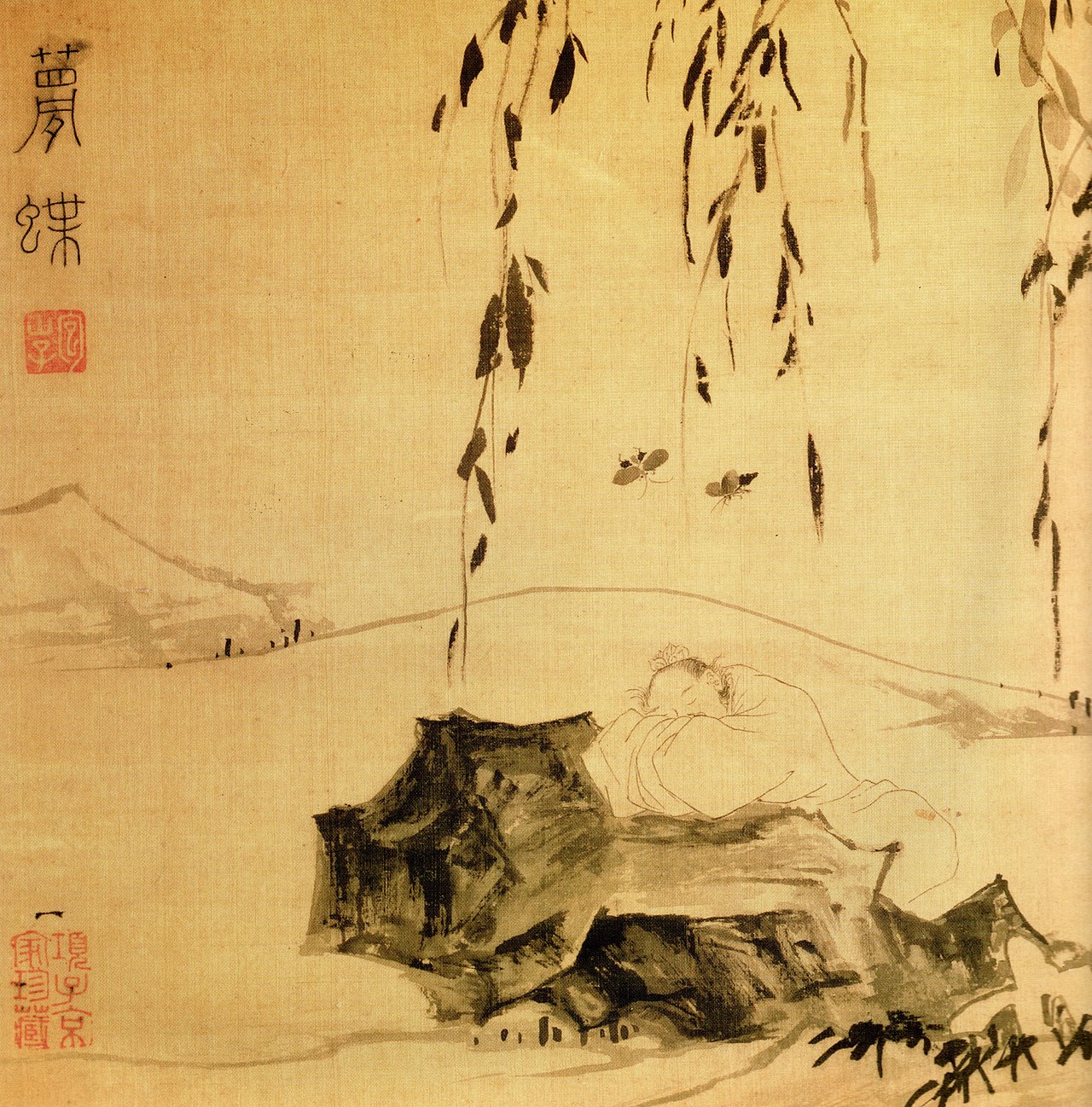
Zhuangzi fell into a deep sleep and dreamed he was a brightly colored butterfly. The philosopher fluttered happily in the warm light of the afternoon sun. This winged creature felt entirely carefree and blissfully ignorant of any human existence. The sleeping dreamer completely forgot he was a mortal man with earthly obligations. His mind existed purely as a creature of the unpredictable wind.
Then, he suddenly woke up from the deep slumber. The scholar realized he was the solid, earthly man named Zhuangzi. Yet a profound and unsettling doubt immediately seized his awakening mind. Was he a mortal man who had just dreamed of winged flight? Or was he now a resting butterfly currently dreaming of a man?
The Zhuangzi butterfly dream violently dismantles our rigid perception of the waking world. The brief anecdote uses the delicate insect to question reality itself. The insect embodies fluid identity and the grand illusion of physical form. The creature moves between states of being without heavy emotional attachment, prompting observers to doubt their own senses.
Chinese folklore also embraces this transient, winged beauty in its storytelling. The legend of the Butterfly Lovers is a foundational tale of tragic romance. Liang Shanbo and Zhu Yingtai share a beautiful but ultimately doomed connection. The two young lovers are cruelly denied union in their mortal lives. The couple dies in deep sorrow and is buried in the cold earth.
Upon death, their souls experience a miraculous and beautiful transformation. The lovers emerge from the grave as a pair of brightly colored butterflies. The colorful pair flies away together, finally free from rigid societal constraints. The insect bridges the massive, silent gap between the living and the dead. The resulting myth symbolizes eternal love enduring long past physical decay.
⚔️ The Samurai and the Fragile Soul
In Japan, the archetype takes on a surprising and deeply martial weight. The Shinto tradition holds the natural world in deep, quiet reverence. Japanese culture views butterflies as the swift, silent carriers of wandering souls. These winged guides transport the spirits of both the living and the dead.
The Japanese word for this delicate insect is chō. The creature embodies the sudden, fleeting transience of life itself. Despite their fragile nature, they were adopted by fierce, blood-soaked warriors. The Samurai class embraced the butterfly as a powerful and respected emblem. Many elite warrior families used the insect directly on their armor crests.
Choosing a delicate insect seems like a strange choice for heavily armored men. Yet the fragile wings perfectly mirrored their own violent and unpredictable existence. A Samurai could fall in battle at any given moment. Martial existence was expected to be beautiful but painfully brief. The butterfly honored this harsh, undeniable reality of martial life.
The famous Taira clan proudly adopted the butterfly as their family crest. This powerful warrior family heavily dominated Japanese politics in the 12th century. Their heavy armor featured the ageha-chō, or the swallowtail butterfly. The elegant wings adorned the silk banners of men marching to bloody wars. The samurai code of Bushido heavily emphasized a beautiful, honorable death. Dying with absolute honor was far more important than surviving in quiet disgrace.
The insect does not shy away from impending death. The fragile creature embraces the brief flash of brilliant color before ending. Such cultural reverence reveals a deep psychological tension within the myth. Contemporary seekers often look to animal spirit guides for permanent comfort, seeking gentle reassurance and safety from the Monarch’s flight.
However, the old traditions recorded something much more volatile and demanding. The wings are physically light, but the cultural message carries immense weight. The Samurai saw the insect as an unflinching mirror for sudden mortality, a silent witness to the rapidly vanishing present. Observing the insect forced an acceptance of inevitable endings. Man and insect both flashed their colors brightly before returning to the dark. Martial history replaced comfort with a fierce appreciation for the temporary.
🌪️ Hopi Rain and the Dust on the Wings
A complex and unresolved legacy trails behind the mythological figure. The persistent symbol refuses to stay neatly categorized by any single culture. In North America, the Hopi people maintain a sacred, enduring tradition. Indigenous communities perform the Bulitikibi, or the traditional Hopi butterfly dance. This important social event happens during the intense late summer heat.
The ceremony functions as a vibrant, two-day petition to divine forces. The dedicated dancers ask the open sky for heavy rain and lasting health. Participants pray for lasting fertility and a long life for everyone. The tribe invokes the winged insect to ensure community survival. The Hopi butterfly dance is not a solemn, quiet affair. It is a joyful, loud celebration filled with vivid colors and music.
Unmarried girls wear elaborate headdresses decorated with bright butterfly imagery. Male chorus members sing traditional songs while the young women dance. The steps perfectly mimic the erratic, fluttering flight of the insect. The community hopes the rhythmic dancing will attract heavy rain clouds. Moisture remains vital for the late summer corn harvest. The butterfly becomes an agent of earthly continuation and physical sustenance.
Further north, the Blackfoot tradition ties the insect directly to sleep. The Blackfoot people understood the delicate wings as quiet messengers of the night. Sleep was considered a highly vulnerable state for a young infant. A mother would sit by a small fire in the quiet evening hours. The woman paints a delicate butterfly motif onto a small scrap of buckskin. She gently ties the painted leather directly to her sleeping baby’s hair. This quiet, sensory act invites benevolent spirits to bring sweet, protective dreams.
The connection between the winged messenger and the sleeping mind remains deeply intimate in Blackfoot tradition. The painted talisman acts as a gentle guardian of the vulnerable, sleeping mind. Yet a central tension remains completely unresolved across all these global traditions. The butterfly strongly symbolizes the eternal, immortal nature of the human soul. The immaterial essence is the part of us that survives physical destruction.
However, the biological insect lives for only a few fleeting days. The tiny insect acts as the perfect definition of ephemerality in art. How can the ultimate symbol of eternity be so physically fragile? The question haunts the edges of every cultural myth. The archetype demands that we hold both conflicting truths at once.
The human soul may endure forever in the dark, silent unknown. But the beautiful, winged form it takes is always vanishing before our eyes. The ancient traditions do not attempt to solve this biological riddle. Elders simply observe the insect fluttering quietly over the open graves. The vibrant wings turn to dust the exact moment you grasp them. The myth ultimately demands that we let the beauty fly away.
The Obsidian Chrysalis and the Cost of Flight
We look at a butterfly today and see only the final flight. The violent struggle of the chrysalis is often ignored. Yet the ancient stories refuse to let us forget the true cost of change. She might wear delicate wings of breath or heavy blades of volcanic glass. The mythological insect always demands total surrender to the dark.
Transformation lacks any peaceful transition. The original body completely dismantles itself. The creature becomes liquid before touching the sky.
Contemporary culture frequently borrows the beautiful wings without acknowledging the heavy toll. Observers want the vibrant colors without the terrifying dissolution. Yet figures like Ītzpāpālōtl and Psyche stand guard at the threshold of mythic change. They hold the ancient memory of survival. The obsidian goddess still waits in the shadows of the physical world. She offers no gentle comfort to the dying caterpillar. Her jagged wings catch the fading light of the afternoon sun. She demands the old self as payment for the open sky.
❓ Frequently Asked Questions
What is the spiritual meaning of the butterfly?
The spiritual meaning centers on the soul’s survival through radical, often violent transformation. Because the insect must completely dissolve its original physical form to gain wings, ancient traditions adopted it as the ultimate emblem of resurrection and the immortal spirit outlasting earthly decay.
Why do some cultures view butterflies as warning signs?
Certain mythologies associate the insect’s sudden appearance with the immediate presence of wandering spirits or fallen warriors. In these traditions, the fragile wings serve as a stark reminder of life’s fleeting transience and the unpredictable, ever-present reality of sudden mortality.
What does a dragonfly symbolize compared to a butterfly?
While the butterfly represents the complete dissolution and rebirth of the soul, the dragonfly typically symbolizes mental clarity, swift adaptability, and mastering the illusions of the physical world. The dragonfly’s life cycle emphasizes rising from murky depths into the light, whereas the butterfly emphasizes surviving the dark isolation of the chrysalis.
For a broader understanding of this symbolic tradition, explore our complete guide to Why Animal Symbolism Awakens the Primal Mind.
Explore Related Topics

Dalton Treviso is an independent researcher and writer exploring archetypes, Jungian psychology, and mythological symbolism. His work focuses on how ancient philosophical traditions and symbolic systems illuminate the hidden structures of the human psyche.
Drawing on Jungian psychology, Stoic thought, and comparative mythology, Dalton examines how the inner patterns we carry shape perception, conflict, and transformation.
Through EINSOF7, he writes about the symbolic architecture of the mind — exploring how myths, archetypes, and philosophical traditions act as both mirror and map for psychological depth and self-understanding.
Areas of study: Jungian archetypes, animal symbolism, dream symbolism, mythological figures, and ancient symbolic traditions.